
How to Advocate for School Support: A Practical Guide
Preparation, partnership and persistence: how to secure the right support for a child in England, without confrontation or legal expertise.

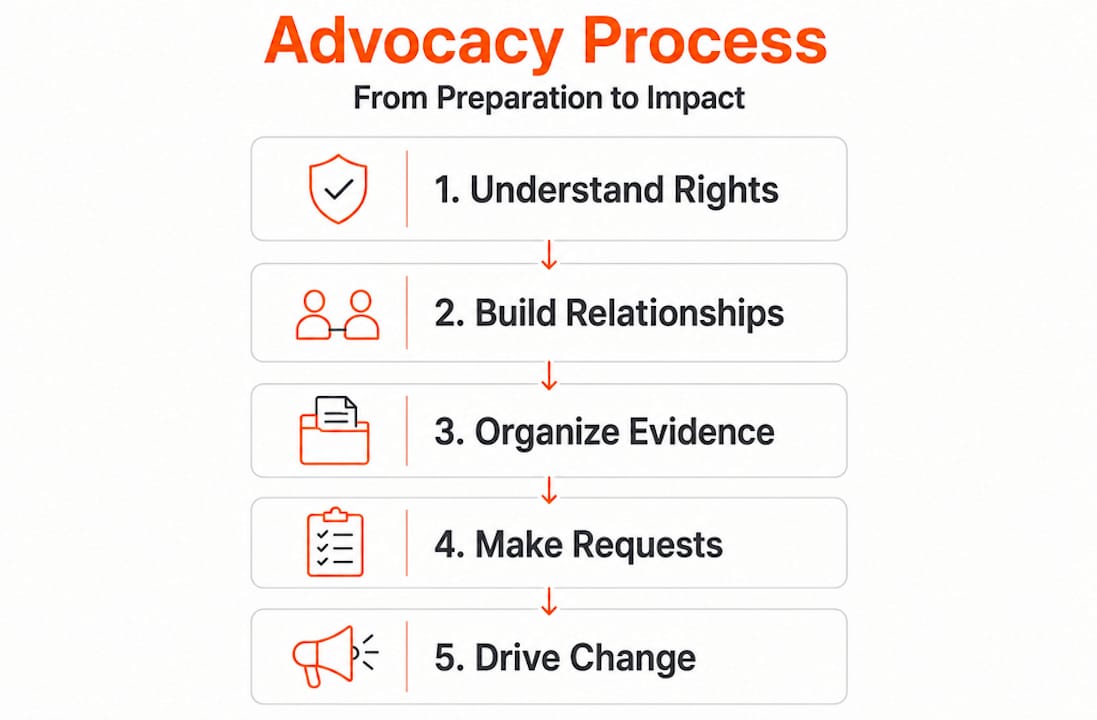
Knowing how to advocate for school support is one of the most valuable skills a parent or carer can develop, yet most people start with genuine uncertainty about where to begin. Children with special educational needs and disabilities (SEND), learning differences, or unmet wellbeing needs are too often underserved, not because schools lack compassion, but because the systems meant to identify and respond to those needs are stretched. Effective advocacy does not require confrontation or legal expertise. It requires preparation, persistence, and a clear understanding that the goal is shared: better outcomes for children who depend on the adults around them to speak up. Plain-language definitions of the terms used here are in our glossary.
Knowing your rights in England
Before any conversation with the school, it helps to understand the framework that governs support. In England, support for SEND is set out in the SEND Code of Practice (2015), statutory guidance under the Children and Families Act 2014. Most needs are met through SEN support in mainstream school, led by the class teacher and the special educational needs coordinator (SENCo) using the graduated approach of assess, plan, do and review. Where needs are more complex, a parent, young person or school can ask the local authority for an education, health and care (EHC) needs assessment, which can lead to an EHC plan setting out provision the authority must secure.
Separately, the Equality Act 2010 requires schools to make reasonable adjustments so that disabled pupils are not put at a substantial disadvantage. Knowing which route applies, SEN support, an EHC plan, or a reasonable adjustment, helps you understand who attends a meeting, what is on the table, and what safeguards apply. Our explainer on reasonable adjustments in schools covers this in detail.
Common types of support an advocate can ask about include:
- Targeted teaching and intervention from the class teacher, a teaching assistant or a specialist, in addition to high-quality classroom teaching.
- Specialist services such as speech and language therapy or occupational therapy where a need is identified.
- Assistive technology, including text-to-speech, reading tools, or planning and organisation aids.
- Support for behaviour and wellbeing, including pastoral support and, where appropriate, input from an educational psychologist.
- A request for an EHC needs assessment where ordinary SEN support is not enough.
Using the right terms gives you credibility. When you ask about the graduated approach, SEN support or an EHC needs assessment, school teams recognise you as a prepared participant, and that changes the dynamic of the conversation.
Building partnerships with educators
The most effective advocates arrive as collaborators, not complainants, and consistently see better outcomes than those who come prepared for conflict. This is not a soft observation; it reflects how schools work. Staff are more likely to go the extra mile for a child when the adults in that child's life treat them as partners.
Starting early matters. A brief, positive email at the start of the year, introducing yourself, noting one or two of your child's strengths, and asking what you can do at home to reinforce classroom learning, signals that you are invested and cooperative. That goodwill is exactly what you draw on later when you need to raise a concern.

Concrete ways to build and keep productive partnerships:
- Arrange brief check-ins rather than waiting for parents' evening.
- Acknowledge teachers' efforts specifically, not generically.
- Ask open questions such as "What patterns are you noticing?" rather than "Why isn't this working?"
- Share evidence-based support practices you have researched.
- Keep messages concise and focused, to respect teachers' time.
Empathy is a practical tool, not just a virtue. Recognising that most teachers manage thirty or more pupils with finite resources helps you frame requests that are realistic and more likely to be accepted.
Organising your advocacy: documentation and preparation
Preparation separates advocates who get results from those who get sympathy. A few concrete pieces of evidence, such as samples of work, assessment results, notes of what helps and what does not, and teachers' comments, turn an impression into a pattern the school can act on.
A practical system does not need to be complex. A single folder, physical or digital, works well:
- Log every communication. Record the date, the method (email, phone, in person), who was there, and a brief summary of what was discussed and agreed.
- Collect formal records. Ask for copies of reports, assessment results, any existing SEN support plan or EHC plan, and records of any incidents.
- Record specific observations. Note incidents with dates, times and settings. "On three consecutive Wednesdays in October my child could not complete more than two questions before needing help" is far more useful than "struggled to focus in maths".
- Prepare a short agenda. Send a brief agenda before a meeting; it signals preparation and ensures your concerns are formally noted.
- Follow up in writing. A neutral email summary of what was discussed and agreed creates a record that protects everyone if a disagreement later goes to mediation or the SEND Tribunal.
| Documentation type | Purpose | Format |
|---|---|---|
| Communication log | Track all contact with school staff | Spreadsheet or dated notes |
| Formal records | Provide an academic and SEND baseline | Printed or digital copies |
| Observations | Demonstrate patterns over time | Dated journal of specific examples |
| Meeting summaries | Confirm agreements in writing | Follow-up email within a day or two |
A practical note: when reviewing a proposed SEN support plan or EHC plan, compare it against a clear set of criteria before you agree to it. Our student support plan checklist is a useful starting point for spotting gaps.
Making clear requests and navigating obstacles
Knowing what you need is one thing; communicating it so the school acts is another. The most reliable approach frames requests as solutions rather than criticisms, tied to outcomes the school already cares about, such as reading progress, attendance or engagement.
- Use observations tied to evidence. "Reading has slowed across the last three assessments" carries more weight than "nothing is improving".
- Set one concrete, achievable goal per meeting. Five concerns at once dilutes each; prioritise the most urgent and hold the rest for a follow-up.
- Separate the problem from the person. A teacher who has not yet put an adjustment in place may be overstretched rather than unwilling; address the gap without assigning blame.
- Escalate deliberately. If the class teacher cannot resolve a concern, the usual route is the teacher, then the SENCo, then the headteacher, then the school's governing body through its complaints procedure. For decisions about EHC needs assessments or plans, you can appeal to the First-tier Tribunal (SEND); complaints about how a local authority handled a process can go to the Local Government and Social Care Ombudsman.
- Involve the child. The SEND Code of Practice puts the views of the child or young person at the centre of decisions. A young person who can say "I understand better when instructions are written down" can shift the whole tone of a meeting, and building that self-advocacy is an investment in their independence.
Managing your own emotional state matters too. If a meeting becomes charged, asking for a short break or a follow-up is not weakness; it stops agreements made in frustration from undoing months of progress.
Free, independent advice is available throughout. Every local authority funds a SEND information, advice and support service (SENDIASS), and the charity IPSEA offers free, legally based advice on assessments, plans and appeals.
Advocating beyond your own child
Advocacy for one child secures support for one child; collective advocacy can change the conditions that affect many. Schools in England are accountable to a governing body or academy trust, and to the local authority for SEND, so there are real routes for parents to influence provision.
Practical ways to widen your impact:
- Engage with the governing body or trust, which oversees the school's SEND policy and the use of its budget, including the notional SEN budget and the pupil premium.
- Join or support a parent carer forum. Every area has one, and local authorities are expected to involve them when planning and reviewing SEND services through the Local Offer.
- Respond to consultations on the local authority's Local Offer and SEND arrangements, where parent input genuinely shapes decisions.
- Volunteer or mentor, or support school fundraising for specific classroom resources, which directly benefits pupils.
Understanding how funding flows, from central government to local authorities and schools, helps advocates press for support to reach the pupils who need it most.
Advocacy works best as a relationship
One pattern recurs. Parents sometimes arrive at a meeting with a folder full of documentation and still leave without the support their child needs, because the documentation was used as evidence of the school's failure rather than as a shared starting point. Others, with far fewer records, secure meaningful support because they sit down with staff as genuine partners in a shared outcome. The technical elements of advocacy, knowing the SEND framework, keeping a paper trail, framing requests as solutions, matter, but they work best as a safety net rather than an opening move.
The piece most easily overlooked is the child. When a young person can describe their own needs, that often achieves more than several emails from an adult. Teaching children to speak up for themselves is both a long-term investment and an immediate, undervalued advocacy tool. Above all, persistence matters: systemic change needs sustained presence, and individual change needs follow-through. Neither happens in a single meeting.
How Qwixl:Milo supports your advocacy

Effective advocacy depends on timely, organised, credible evidence of how a child learns. Qwixl:Milo is built for exactly that. Working in Google Docs, it surfaces processing indicators (signals, not diagnoses) as your child writes, and its evidence pack turns those signals into an organised summary you can bring to a meeting with a teacher or SENCo. It does not diagnose or replace the school's statutory process; it means you can arrive with structured, data-supported observations rather than anecdote alone. Where a school wants the same kind of visibility across a whole class, the teacher-facing Qwixl:Homework platform plays the equivalent role for staff.
FAQ
What does it mean to advocate for school support?
It means actively working to secure appropriate support for a child by communicating with school staff, understanding the SEND framework (the SEND Code of Practice, SEN support, EHC plans, and reasonable adjustments under the Equality Act 2010), and building collaborative relationships with teachers and the SENCo.
How do I request support for my child?
Raise your concerns in writing with the class teacher and the SENCo, referencing specific observations and the support you think is needed, and follow up any verbal conversation with a brief email summary. If SEN support is not enough, you can ask the local authority for an EHC needs assessment.
What are the most effective advocacy tips?
Build relationships with staff early, document communications and observations, frame requests around outcomes the school values, and involve the child in expressing their own needs during meetings.
Where can I get free, independent help?
Every local authority funds a SEND information, advice and support service (SENDIASS). The charity IPSEA offers free, legally based advice, and local parent carer forums represent families and feed into the local authority's SEND planning.
When should I escalate a concern?
Escalate when a concern raised with the teacher and SENCo has not been resolved: progress to the headteacher, then the governing body's complaints procedure. Decisions about EHC needs assessments or plans can be appealed to the First-tier Tribunal (SEND), and complaints about how a local authority handled a process can go to the Local Government and Social Care Ombudsman.
Sources and further reading
- SEND Code of Practice: 0 to 25 years (2015)
- IPSEA, Asking for an EHC needs assessment
- gov.uk, Disabled people's education rights (Equality Act 2010)
- First-tier Tribunal (Special Educational Needs and Disability)
- SENDIASS / IAS Services network