
Why Teacher Retention Links to Support Tools
What UK and international research suggests about workload correlates, support tools and retention intentions.
Why Teacher Retention Links to Support Tools

Teacher retention in England is closely associated with workload, organisational support and the balance between job demands and job resources. Well-chosen support tools can help schools signal investment in staff wellbeing and reduce specific administrative burdens, but the research base is clearer on which tasks correlate with retention intentions than on whether any particular digital platform causally reduces turnover. This article summarises UK evidence from the Department for Education (DfE) and NFER, alongside international theory and studies that school leaders should read with jurisdiction in mind.
NFER (2026), funded by the Nuffield Foundation, finds that teachers who feel they spend too much time on lesson planning, pupil behaviour management and pastoral support are among the key factors associated with retention. These findings are cross-sectional: they describe patterns in survey and workforce data, not proven cause-and-effect from deploying tools. Understanding why retention and support tools are often discussed together still requires both the UK data and the theoretical frameworks below.
Why teacher retention links to support tools
The academic framework underlying this relationship is well established. Organisational Support Theory holds that employees who perceive their organisation as invested in their wellbeing tend to report greater commitment and lower turnover intentions. The Job Demands-Resources (JD-R) model extends this by identifying two competing forces in every teacher's experience: job demands that deplete energy and job resources that restore it. Support tools are sometimes positioned on the resources side of that equation when they genuinely reduce task burden rather than add another layer of administration.
A 2026 study of 520 novice teachers in Guizhou Province, China reported that organisational support was associated with lower turnover intentions through pathways involving induction adaptation and reduced burnout. That sample is not UK-specific, and the authors describe a more complex mediation pattern than a simple linear chain. Still, the study illustrates why induction-period support matters during early career, when attrition risk is often highest.

In United States data, the Learning Policy Institute (2026) estimates predicted turnover probability of about 8.0% for teachers with high job satisfaction versus about 22.0% for those with low satisfaction, with leadership quality and stress among the associated drivers. That framing is useful for comparison, but it should not be presented as a UK headcount. Support tools that reduce administrative stress and strengthen leadership communication may support retention as part of a wider wellbeing strategy, not as a standalone guarantee.
How do support tools reduce job demands to improve teacher retention?
The specific job demands driving workload stress are well documented in England. NFER's 2026 analysis associates retention intentions with teachers feeling they spend too much time on:
- Lesson planning and curriculum preparation
- Pupil behaviour management
- Pastoral care and safeguarding administration
Marking and written feedback are a major workload concern in UK surveys, but NFER's retention report does not name marking among its key correlates. For marking specifically, DfE's Working Lives of Teachers and Leaders (WLTL) wave 3 (2024) found 43% of teachers felt they spent too much time on marking, and wave 4 (2025) reports 38%. WLTL wave 4 also records teachers working about 46.9 hours per week on average in 2025. In the same survey, 44% felt they spent too much time on planning in 2024. These figures describe self-reported workload pressure; they do not by themselves prove that a given tool will change retention.
Other common demands include communication with parents and caregivers, which can escalate in volume without adequate systems. Each demand, left unaddressed, can compound into chronic stress. Support tools that streamline feedback workflows, organise records or centralise communication may reduce cognitive and temporal load when they are adopted thoughtfully and matched to real tasks. Our article on digital tools in formative feedback discusses how assignment-centred platforms can support feedback quality; schools should audit whether any tool actually reduces marking hours in their context rather than assuming it from marketing claims.
Pro Tip: When selecting support tools for your school, prioritise platforms that consolidate multiple workflow tasks. A tool that handles feedback, tracks behaviour patterns and communicates with parents in one interface reduces the burden of switching between systems, which is itself a source of cognitive fatigue.
Administrative workload and long working hours are plausible leverage points for retention efforts, especially among early-career teachers. Evidence that a specific tool produces measurable turnover reduction in UK schools is limited; implementation quality, leadership culture and whether the tool replaces or adds work matter at least as much as the product label.
What role does organisational support theory play in retention?
The JD-R model provides a useful framework for understanding why some support tools are adopted and others resisted. The model predicts that when job demands consistently outpace job resources, burnout risk rises. When resources match or exceed demands, engagement and commitment may increase. Support tools function as job resources only when they reduce real task burdens and are perceived as helpful rather than surveillant.
The China novice-teacher study described a sequential mediation pathway worth noting for school leaders: organisational support, induction adaptation, reduced burnout and turnover intentions. That chain suggests tools deployed during induction, such as structured onboarding platforms, mentoring coordination systems and workload management aids, may matter most in years 1-3. Again, this is associative evidence from one national context, not a UK RCT.
| Pathway | Mechanism | Retention effect (cautious) |
|---|---|---|
| Organisational support to induction adaptation | Tools may reduce early-career overwhelm | Associated with lower turnover intentions in years 1-3 (China study) |
| Induction adaptation to reduced burnout | Smoother onboarding may preserve motivation | Associated with sustained engagement |
| Reduced burnout to lower turnover intentions | Emotional resources remain intact | Teachers may commit longer-term |
| Job resources to engagement | Collegial tools may strengthen relationships | May reduce isolation and attrition risk |
The contrast between early-career and experienced teachers is significant. Novice teachers are disproportionately affected by inadequate support because they lack the coping strategies and professional networks that experienced colleagues have built over time. Support tools designed with induction in mind, including those that facilitate peer connection and structured reflection, may address this asymmetry when paired with human mentoring rather than replacing it.
How do digital tools practically impact teacher retention rates?
Evidence that digital tools improve retention is narrower than headlines sometimes suggest. A 2026 report on a US preschool randomised trial in New Jersey low-income districts described roughly 23 percentage points higher teacher retention in a treatment group using the SmartTeach platform within the Teaching Strategies ecosystem (about 80.6% versus about 50.8% in the control group), according to NIEER analysis cited by Route Fifty. That result is United States preschool-specific and bundled with professional development; it should not be generalised to UK secondary marking workflows or homework platforms.
Commentary on that trial also notes that viewing support tools as workflow value-adds rather than replacements for professional judgement may improve adoption. Teachers who perceive technology as surveillance or as an additional administrative layer often resist it. Teachers who experience it as genuinely reducing burden are more likely to adopt it.
Digital tools can support student outcomes alongside teacher wellbeing, which may create a reinforcing cycle. When teachers see pupils progressing through clearer feedback systems, their sense of professional efficacy may increase. That efficacy is itself a job resource that buffers against burnout. See our guide on formative assessment for teachers for evidence on feedback practice, separate from retention claims.
Pro Tip: Before deploying any new digital platform, audit which specific tasks consume the most teacher time in your school. Match tool capabilities to those tasks precisely. A tool that solves a problem teachers do not actually have will add friction, not reduce it.
What job resources do support tools create for teacher wellbeing?
A 2026 Frontiers systematic review of 366 studies on job demands and resources in education identified protective job resources including:
- Collegial support and peer collaboration, which reduces professional isolation
- Positive relationships with school leaders, which signals organisational investment in teacher welfare
- Autonomy and professional agency, which preserves intrinsic motivation
- Access to professional development, which builds competence and confidence
- Clear communication channels, which reduce ambiguity and administrative confusion
Support tools can amplify these resources when implemented thoughtfully. Collaboration platforms may connect teachers across year groups. Leadership communication tools can make support visible. Professional development platforms can extend learning without requiring teachers to sacrifice personal time.
In United States research published in Kappan, high-retention districts studying novice science teachers prioritised supportive colleague relationships and resource availability. Tools in those districts were selected to support relationships and access, not chosen arbitrarily. The link between tools and retention in that work is interpretive rather than experimental.
Reducing marking time through more efficient feedback workflows can simultaneously reduce a demand and create a resource: time redirected toward collaboration, planning or recovery. That dual effect helps explain why workload reduction is often discussed alongside retention, even when causal evidence for any one product remains thin.
How can school leaders implement support tools to maximise retention?
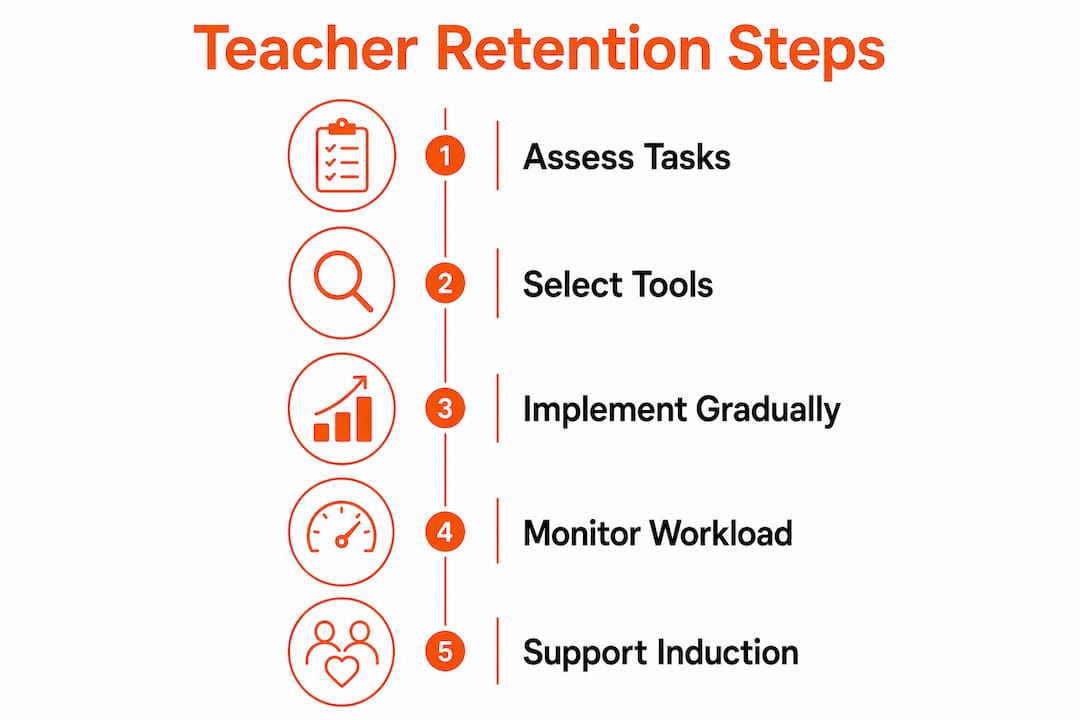
Effective implementation begins with mapping tools to the tasks that consume the most teacher time and generate the most stress. NFER's analysis highlights lesson planning, behaviour management and pastoral administration as factors associated with retention intentions. DfE WLTL separately documents high proportions of teachers reporting excessive time on planning and marking. Any tool that does not address at least one verified pain point in your own school is unlikely to change how staff feel about staying.
Induction and onboarding deserve particular attention. International research suggests the induction period is when organisational support may have its greatest leverage on long-term retention intentions. Schools that deploy structured onboarding, assign mentoring and reduce administrative complexity for new teachers in their first year are investing at a high-risk stage.
Measurement matters. Schools that implement support tools without tracking workload perceptions, burnout indicators or satisfaction cannot know whether those tools are working. In US contexts, LPI discusses turnover replacement costs and satisfaction associations as reasons to measure baseline conditions before interventions. The same principle applies in England: start from DfE WLTL-style workload questions and local exit-interview themes.
The risk of adding technological burden is real. Every new platform requires training, adaptation and ongoing maintenance. School leaders must weigh the cognitive cost of adoption against the workload reduction the tool delivers. Tools that require extensive configuration or duplicate existing systems can increase demands rather than reduce them.
Our guide on teacher workload, marking and what inspectors do not require reinforces that reducing unnecessary administrative demands is both a wellbeing intervention and a sensible retention strategy. The two are closely linked even when Ofsted does not mandate specific marking policies.
Key takeaways
Teacher retention is influenced by the balance between job demands and job resources. Support tools may help shift that balance when they reduce genuine burden and are backed by leadership culture, but UK evidence is stronger on workload correlates than on product-specific turnover effects.
| Point | Details |
|---|---|
| NFER associates planning, behaviour and pastoral load with retention | Cross-sectional UK data; causality and digital tools not tested. |
| Marking workload is a major DfE WLTL concern | 38-43% of teachers reported too much marking time (2024-25); not named in NFER retention correlates. |
| Induction is a high-leverage period | International research links early-career support to lower turnover intentions. |
| US satisfaction data shows large turnover-probability gaps | LPI: about 8.0% predicted turnover (high satisfaction) vs about 22.0% (low); label as US evidence. |
| US preschool RCT showed a large retention gap | SmartTeach trial about +23 pp in NJ preschool only; not generalisable to UK K-12. |
| Measurement must accompany implementation | Baseline workload and satisfaction data are needed to judge whether tools help. |
Why support tools are still an underused retention lever
Despite growing workload evidence, many schools still treat support tools as procurement decisions rather than retention signals. A common pattern is deploying technology because it is current or because neighbouring schools use it, without anchoring the choice to a specific workload or retention problem documented in local data. That approach often produces adoption fatigue rather than measurable relief.
A more productive framing is to treat every support tool as a signal of organisational investment. When teachers see that their school has chosen a platform specifically to reduce marking load or to make behaviour tracking less burdensome, they may experience that choice as evidence that leadership values their time. That perception of being valued can support retention independently of the tool's functional benefits.
Schools that combine well-chosen tools with strong leadership relationships and structured professional development tend to report better staff experience than those relying on technology alone. Reducing unnecessary administrative demands remains both a wellbeing intervention and a retention strategy.
How Qwixl supports teacher retention through smarter tools

Qwixl:Homework is designed for teachers and SENCos managing assignments, AI-assisted marking and class-level feedback workflows. It aims to reduce the time spent on written assessment while keeping teachers in control of professional judgement, and can surface typing-based screening signals where schools enable capture (signals, not diagnoses). For schools addressing workload and retention together, explore Homework to see how assignment-centred feedback might fit your marking and pastoral routines. Where pupils use Google Docs at home, Qwixl:Milo offers in-context student-side support; it is secondary to Homework for this teacher-focused topic.
FAQ
Why do teachers leave jobs at such high rates?
Workload, administrative burden and insufficient organisational support are among the factors associated with turnover in international research. In United States data, LPI (2026) links low satisfaction and leadership stress to higher predicted turnover. UK schools should combine NFER and DfE WLTL workload evidence with local exit-interview themes rather than importing US percentages as UK facts.
How do support tools improve teacher satisfaction and retention?
Support tools may reduce job demands such as marking, behaviour tracking and lesson planning when they replace genuine burden rather than adding systems. A China-based 2026 study associated organisational support with lower turnover intentions through induction adaptation and lower burnout. UK causal evidence for specific products remains limited.
What are the best practices for deploying support tools to retain teachers?
Map tools to the highest-cost tasks in your school using DfE WLTL and local audits, prioritise induction-period support for early-career teachers, and measure workload and satisfaction before and after implementation. Tools that consolidate multiple workflow tasks may deliver more benefit per adoption cost than single-purpose apps.
Does technology alone improve teacher retention?
Technology alone is unlikely to improve retention. US preschool trial commentary suggests tools framed as workflow enhancements rather than replacements may achieve better adoption. Effective strategies combine digital tools with leadership relationships and professional development.
How does burnout connect to teacher turnover intentions?
Burnout is often discussed as a mediator between inadequate organisational support and intentions to leave teaching, including in JD-R-based studies. Reducing burnout through workload reduction and leadership practices is a concrete strategy for lowering turnover intentions, though tool choice should follow evidence rather than vendor claims.
Sources and further reading
- NFER (2026), What helps to improve teacher retention?
- DfE (2025), Working Lives of Teachers and Leaders, wave 4
- DfE (2024), Working Lives of Teachers and Leaders, wave 3
- Learning Policy Institute (2026), Teacher Turnover in the United States (US)
- Lu & Ma (2026), Frontiers in Psychology (China novice teachers)
- Moens et al. (2026), Frontiers in Education systematic review
- Route Fifty / NIEER (2026), US preschool SmartTeach trial summary (US)
- Kappan, Why teachers stay (US districts)