
The role of digital tools in formative feedback
Digital feedback can speed loops and surface class patterns; responsive teaching still matters.
The Role of Digital Tools in Formative Feedback

Formative feedback sits at the center of effective teaching, yet most educators know the reality: providing consistent, timely, and meaningful feedback to every pupil is extraordinarily difficult at scale. The role of digital tools in formative feedback has shifted from a peripheral convenience to a practical lever for timelier loops. The EEF Teaching and Learning Toolkit: Feedback notes digital feedback averages about four months' additional progress versus about six months overall for feedback approaches, with quality and teacher oversight still central, particularly as classrooms grow more diverse and teacher workloads intensify. What the research now confirms is not that technology replaces the professional judgment of educators, but that it amplifies their capacity to reach pupils at precisely the moments when feedback matters most.
Table of Contents
- Key Takeaways
- Why formative feedback quality determines student outcomes
- How digital tools transform formative feedback practices
- Best practices for implementing digital formative feedback tools
- Evaluating the impact and challenges of digital formative feedback tools
- My perspective on the evolving role of digital formative feedback
- How Qwixl supports formative feedback and learning insight
- FAQ
Key Takeaways
| Point | Details |
|---|---|
| Digital tools amplify, not replace, teachers | Technology handles routine feedback tasks so educators can focus on high-level mentorship and instructional decisions. |
| Real-time feedback changes learning speed | Immediate digital feedback reduces the gap between error and correction, directly supporting pupil self-regulation. |
| Integration into workflows drives adoption | Digital tools embedded in existing LMS platforms show significantly higher adoption and impact than standalone systems. |
| Human oversight remains non-negotiable | AI-generated feedback requires active educator review to maintain quality, fairness, and accuracy. |
| Engagement benefits are well-documented | Recent longitudinal research shows AI-enabled feedback design improves behavioral, cognitive, and emotional pupil engagement. |
Why formative feedback quality determines pupil outcomes
Before examining how digital tools change the equation, it is worth establishing what formative feedback actually does in a learner's development and why its quality matters so profoundly.
Formative feedback differs from summative assessment in one critical way: its purpose is to inform ongoing learning rather than to record a final performance level. Where a summative grade tells a pupil where they ended up, formative feedback tells them how to move forward. This distinction shapes everything, from the language teachers use to the frequency with which feedback should occur.
Consistent, low-stakes feedback that is feedback-rich supports self-regulation and academic success, with particular benefit for lower-performing pupils who lack the metacognitive habits to self-correct without guidance. When feedback is irregular, generic, or delayed, pupils lose the connection between their effort and its outcome, which erodes both motivation and learning efficiency.
The challenges educators face in scaling quality feedback are well-documented. Consider what formative feedback actually requires at a practical level:
- Frequency: Feedback must occur during the learning process, not only at its end, to redirect effort before misconceptions deepen.
- Specificity: Vague comments like “good work” or “needs improvement” provide no usable direction; feedback must address the precise gap between current performance and the learning target.
- Timeliness: Feedback loses instructional value when it arrives days after the work is submitted; pupils have often moved on mentally before they see the response.
- Differentiation: Pupils with special educational needs, English language learners, and those with prior knowledge gaps each require feedback calibrated to their specific context.
- Dialogue: The importance of feedback in learning extends beyond correction; it requires a two-way exchange that helps pupils understand their own thinking processes.
When any of these conditions fails, formative feedback underperforms even when teachers invest significant time in it. This is precisely where technology in formative assessment offers a structural solution.
How digital tools transform formative feedback practices
The most significant shift digital tools bring to formative feedback is speed without loss of specificity. Traditional feedback cycles often take days; digital feedback tools compress that cycle to minutes or, in many cases, seconds.

The categories of digital tools now available to educators span a broad functional range. Interactive quiz platforms surface misconceptions in real time, flagging which pupils answered incorrectly and on which concepts, so teachers can adjust instruction during the lesson rather than two days later. AI-assisted writing tools analyze pupil responses for structural, argumentative, and language-level issues, generating feedback drafts that educators can review and personalize. Learning management system integrations allow teachers to deliver feedback directly within the workflow pupils already use for submitting work.
Digital and AI-assisted formative tools provide faster feedback and create lower-stakes environments enabling more frequent practice than manual assessments allow, based on a systematic review of 37 studies. That lower-stakes quality matters enormously for pupils who disengage when feedback feels evaluative rather than developmental.
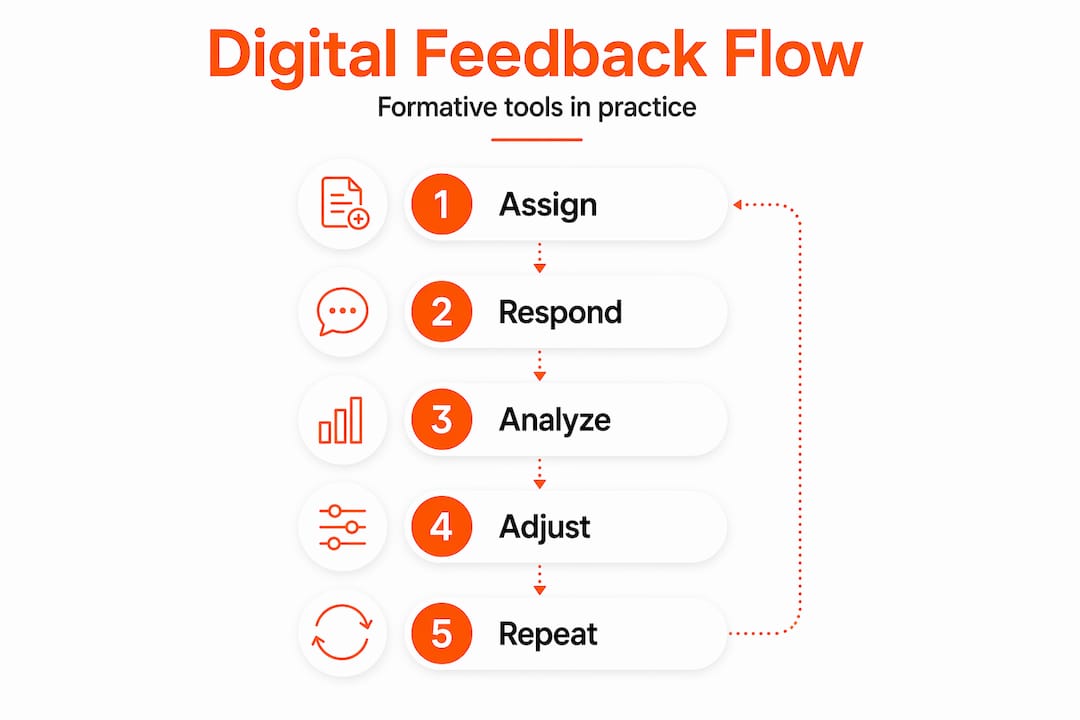
The evidence from schools using these platforms is striking. Some platform evaluations report high teacher satisfaction with real-time formative tools, though independent effect sizes vary by subject, implementation and school context. These numbers reflect not just teacher satisfaction but a measurable shift in how instructional time gets used.
Critically, digital tools allow teachers to manage assessment data with precision, enabling immediate feedback and targeted intervention during lessons without adding administrative burden. This is the operational advantage that makes technology in formative assessment worth the implementation investment.
Pro Tip: When selecting best digital tools for formative assessment, prioritize platforms that surface pupil-level data during the lesson itself, not only in post-session reports. The instructional value of real-time data is categorically different from retrospective analytics.
Best practices for implementing digital formative feedback tools
Knowing that digital tools can improve formative feedback is not the same as knowing how to implement them effectively. School leaders and educators who approach this work strategically see better outcomes than those who adopt tools without a clear framework.
-
Start with the feedback gap, not the technology. Before selecting any platform, identify precisely where your current feedback practice breaks down. Is it timeliness? Is it consistency across a faculty? Is it the inability to differentiate feedback for pupils with SEND? The tool should solve a specific, identified problem.
-
Embed tools within existing workflows. Digital tools integrated into workflows like LMS platforms are more likely to be adopted and impactful than standalone systems. Teachers will not sustain use of tools that require them to leave their existing ecosystems; adoption depends on minimizing friction.
-
Establish clear role separation between AI and educator. A clear role separation where AI handles routine feedback tasks and educators provide high-level guidance improves the overall quality of formative feedback. This is not a passive arrangement. Teachers must actively verify, audit, and override AI-generated feedback when it misses nuance or context that a human would catch.
-
Build pupil feedback literacy alongside tool adoption. Pupils who understand how to read, interpret, and act on digital feedback benefit far more than those who simply receive it. Teaching pupils to engage critically with automated feedback develops the metacognitive skills that make formative processes work, reducing the risk of surface-level compliance without genuine learning.
-
Monitor for defensive motivation patterns. Students' engagement with feedback is influenced by contextual factors including individual defensive motivations, where some pupils respond to feedback by protecting their self-image rather than acting on the guidance. Digital tools do not eliminate this dynamic; educators need to watch for it and intervene with targeted conversations.
Pro Tip: Schedule a structured review of AI-generated feedback samples every two to three weeks with your department or team. This habit surfaces systematic errors or bias patterns before they affect pupil trust in the feedback process.
Evaluating the impact and challenges of digital formative feedback tools
The research base on digital formative feedback tools has grown substantially, with several 2026 longitudinal studies providing particularly useful data on engagement outcomes and limitations.
Some smaller studies suggest AI-enabled feedback design can improve pupil engagement across behavioral, cognitive and emotional dimensions in specific contexts, with the most pronounced effects among pupils who were resistant to traditional feedback formats. This finding is significant for educators working with disengaged learners: the lower-stakes, more frequent nature of digital feedback creates entry points that conventional approaches do not.
The table below summarizes the current evidence on both advantages and challenges:
| Dimension | Evidence | Implication |
|---|---|---|
| Behavioral engagement | Increased task completion and response rates | Digital tools reduce the gap between feedback and pupil action |
| Cognitive engagement | Deeper processing of feedback when scaffolded by AI | Tool design matters; generic prompts yield shallow engagement |
| Emotional engagement | Reduced anxiety in low-stakes digital environments | Particularly beneficial for pupils with SEND or high test anxiety |
| Fairness and bias | AI tools can reflect training data biases | Ongoing human audit is required to maintain equitable feedback |
| Teacher workload | Reduced time on routine marking | Time saved must be reinvested in high-order feedback conversations |
The challenges are real and should not be minimized. AI feedback tools carry the risk of encoding existing biases present in their training data, which can manifest as systematically different feedback quality for different pupil groups. This is not a theoretical concern. It requires schools to build audit habits into their adoption of any AI-assisted feedback platform.
“Effective formative feedback must emphasize dialogue and connection, not just automated responses, to maximize pupil learning and motivation.” Tom Moule, Jisc (2026)
The future direction of these tools points toward increasingly adaptive pathways, where AI analyzes patterns in pupil responses over time and adjusts the type, depth, and focus of feedback accordingly. For school leaders, the strategic question is not whether to adopt these tools, but how to build the institutional structures that keep educators meaningfully in the loop as the technology advances.
My perspective on the evolving role of digital formative feedback
I've spent considerable time working with educators at the intersection of technology and formative practice, and the single most common mistake I see is treating digital tools as a solution to a workload problem rather than as a lever for improving feedback quality.
When a school adopts a digital feedback platform primarily to save teacher time, it often does save time. But the time saved rarely gets reinvested in the high-order, relational feedback that pupils actually need most. The platform ends up replacing human judgment rather than freeing it up.
What I've learned is that the educators who use these tools best are the ones who have thought carefully about how adaptive feedback fits into a deliberate instructional design. They know exactly which parts of the feedback process benefit from automation and which parts require a human voice. They use AI to handle first-pass feedback on structure or correctness, and then they use the time that creates to have the conversations that change how a pupil thinks about their own learning.
The technology is genuinely useful. But it requires educators who understand its limits and take seriously their role as the critical layer of quality control. The research on retaining human oversight is not a warning about AI's inadequacy so much as it is a reminder that the professional expertise of educators is irreplaceable, regardless of how capable the tools become.
How Qwixl supports formative feedback and learning insight

Qwixl was designed with exactly this challenge in mind: how do you give educators the real-time insight and feedback support they need without adding to an already unsustainable workload? Qwixl's platform, including Qwixl:Homework and Milo, integrates AI-assisted marking with the kind of SEN-sensitive insight that helps teachers identify not just what a pupil got wrong, but why patterns in engagement and writing behavior might signal an underlying learning need.
Rather than offering a standalone tool that teachers must manage separately, Qwixl embeds within existing teaching workflows, surfacing formative diagnostics that are genuinely usable in the moment. For school leaders and SENCOs, the platform provides population-level signals that inform intervention decisions without diagnostic labeling. For classroom teachers, it reduces the time between pupil effort and meaningful feedback.
If your school is exploring how to strengthen formative feedback practices through evidence-informed technology, Qwixl offers a grounded, privacy-conscious starting point worth examining closely.
FAQ
What is the role of digital tools in formative feedback?
Digital tools in formative feedback accelerate the feedback cycle, surface misconceptions in real time, and allow educators to differentiate responses at scale. They are most effective when used alongside active teacher oversight rather than as replacements for human judgment.
What are the best digital tools for formative assessment?
The most effective digital formative assessment tools are those integrated directly into existing LMS workflows, provide real-time pupil-level data, and support teacher review of any AI-generated feedback. Platform fit with your school's existing ecosystem matters as much as feature sets.
How does digital feedback improve pupil engagement?
Some studies suggest AI-enabled feedback design can improve engagement for pupils resistant to traditional feedback formats, though evidence varies by tool design and school context.
Why is human oversight still necessary with AI feedback tools?
AI feedback tools can encode training data biases and miss contextual nuance that affects individual pupils. Effective use requires educators to verify, audit, and override AI responses, ensuring feedback remains accurate and equitable for all learners.
How should schools start implementing digital formative feedback tools?
Schools should begin by identifying the specific gap in their current feedback practice, then select tools that address that gap within existing workflows. Building teacher capacity to critically evaluate AI-generated feedback before deploying it to pupils is a prerequisite, not an afterthought.
Sources and further reading
- EEF Teaching and Learning Toolkit: Feedback
- EEF (2021), Teacher Feedback to Improve Pupil Learning
- EEF SEND in Mainstream Schools
Recommended
- How to set up a homework feedback system
- How feedback improves learning outcomes for educators
- Formative assessment: a complete guide for teachers
- How feedback improves learning outcomes for educators
- How to improve written assignment feedback for all learners
- How Adaptive Feedback Helps Students Succeed in Class