
How to improve written assignment feedback for all learners
Rubrics, reflection and targeted comments that pupils can act on, with teacher judgement central.
How to improve written assignment feedback for all learners

Written assignment feedback is one of the most powerful tools a teacher has, yet research consistently shows that pupils often receive comments they cannot act on, do not understand, or simply ignore. This challenge is even more pronounced in classrooms that include pupils with special educational needs and disabilities, English Language Learners, or other diverse cognitive profiles, where a one-size-fits-all response can widen existing gaps rather than close them. This guide brings together evidence-based strategies, practical tools, and inclusive approaches to help teachers and SENCOs deliver feedback that genuinely moves pupil writing forward.
Table of Contents
- Understanding the feedback problem in diverse classrooms
- What you need: Foundations for effective assignment feedback
- Step-by-step: How to deliver high-impact, inclusive feedback
- Adapting feedback for special needs and measurable growth
- What most feedback guides miss: The need for student agency and ongoing reflection
- Level up your feedback process with Qwixl solutions
- Frequently asked questions
Key Takeaways
| Point | Details |
|---|---|
| Rubrics and exemplars | Combining rubrics and clear examples leads to the biggest writing improvements. |
| Individualized feedback | Tailoring comments to pupil needs and support-plan targets ensures better progress. |
| Balanced use of AI | AI can help but should always complement,not replace,human judgment and care. |
| Pupil reflection matters | Building reflection and self-evaluation into feedback cycles drives lasting growth. |
Understanding the feedback problem in diverse classrooms
To tackle the challenge of ineffective feedback, we first need to understand why well-intentioned responses sometimes miss the mark with diverse learners.
Many teachers pour significant time into marking written assignments, only to find that pupils repeat the same errors on the next draft. The problem is rarely effort. It is more often a mismatch between the feedback given and the cognitive, linguistic, or emotional readiness of the pupil to receive and act on it. For pupils with neurodevelopmental conditions such as dyslexia, ADHD, or developmental language disorder, dense marginal comments or vague praise like “needs more detail” can feel inaccessible or even discouraging.
Several barriers compound this challenge in diverse classrooms:
- Processing load: Pupils with working memory difficulties may struggle to hold multiple feedback points in mind while revising.
- Language accessibility: English Language Learners may lack the vocabulary to interpret feedback written at an adult reading level.
- Emotional safety: Pupils who already feel uncertain about their writing may disengage entirely when feedback feels critical rather than constructive.
- Lack of specificity: Generic comments do not tell pupils what to change or how to change it, leaving them without a clear path forward.
Key statistic: Research-backed guidance from New York State emphasizes that individualized, considerate feedback must account for pupils' language development stage, cultural context, and individual needs, particularly in special education and writing intervention settings.
The growing use of AI-generated feedback adds another layer of complexity. While automated tools can process pupil writing quickly, AI feedback often lacks the diagnostic precision and contextual nuance that teacher feedback provides. An AI system cannot know that a pupil's disjointed paragraph structure reflects anxiety about a topic rather than a lack of understanding. It cannot read the room.
The solution is not to abandon technology, but to use it within a framework that keeps teacher judgment central. For a broader look at how unmet needs affect pupil outcomes, the research on supporting pupils with SEND in school settings provides important context for why individualized feedback matters so much.
What you need: Foundations for effective assignment feedback
Recognizing these barriers, the next step is to ensure you have all the foundations in place for effective, differentiated feedback.
Before you can deliver high-impact feedback, certain structural elements need to be in place. Attempting to improve feedback without these foundations is like trying to build on unstable ground. The following components are non-negotiable for inclusive, effective feedback practice.
1. Accessible rubrics
A rubric is only useful if pupils can read and understand it. Rubric accessibility is a genuine concern, particularly when the language used in criteria descriptions exceeds pupils' reading level. For pupils with SEND or younger learners, rubrics should use plain language, short sentences, and visual supports where possible. Consider creating tiered rubrics with simplified language for pupils who need it, while maintaining the same core criteria.

2. Exemplars paired with rubrics
Research shows that rubrics paired with exemplars during the drafting phase improve writing quality at deeper feature levels, including organization, argumentation, and coherence, not just surface-level grammar. Annotated model essays help pupils see what “good” looks like in concrete terms, which is especially important for learners who struggle to translate abstract criteria into actual writing decisions.
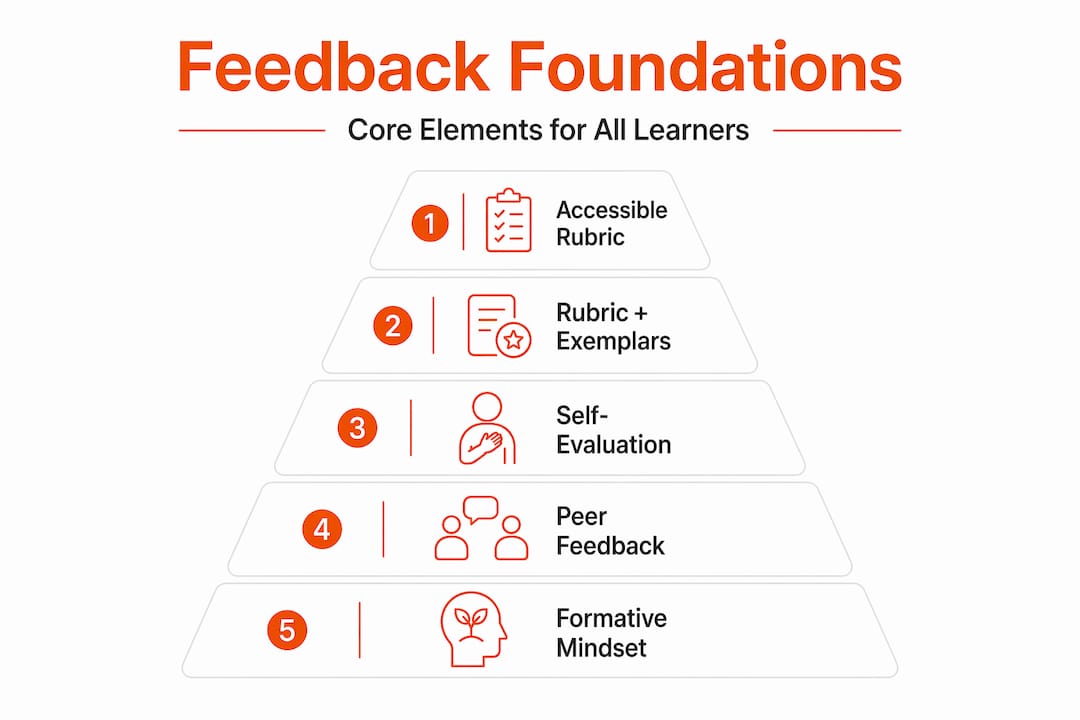
3. Self-evaluation and peer feedback tools
Pupils who evaluate their own work before receiving teacher feedback are better positioned to engage with that feedback meaningfully. Structured self-assessment checklists, sentence starters for peer review, and guided reflection prompts all support this process.
4. A formative mindset
Feedback should be understood, by both teacher and pupil, as a tool for improvement rather than a final judgment. This shift in framing changes how feedback is delivered and how it is received.
| Foundation element | Why it matters | Adaptation for SEN/ELL pupils |
|---|---|---|
| Accessible rubric | Sets clear expectations | Simplified language, visual cues |
| Exemplars | Makes quality concrete | Annotated, discussed in class |
| Self-assessment | Builds metacognition | Guided checklists, sentence starters |
| Formative mindset | Reduces anxiety | Emphasize growth, not grade |
| Peer feedback | Develops critical thinking | Structured protocols, modeled first |
Pro Tip: Before distributing a rubric, read it aloud with your class and ask pupils to explain each criterion in their own words. This quick check reveals which descriptors need simplification and ensures that every pupil, including those with reading difficulties, can access the expectations before they begin writing.
These foundations align with England's graduated approach (assess, plan, do, review), benefiting all learners while targeting additional support where needed.
Step-by-step: How to deliver high-impact, inclusive feedback
Once you've set a strong foundation, follow these steps to review and give feedback for genuine improvement.
A structured, sequential approach to feedback reduces inconsistency and ensures that every pupil receives responses they can act on. The following process draws on current research in writing instruction and SEN pedagogy.
-
Set clear goals before the assignment begins. Share the rubric and exemplars at the start, not after drafting. Pupils who understand the target before writing are more likely to make intentional choices throughout the process.
-
Use the rubric actively during drafting. Encourage pupils to self-check against rubric criteria as they write each paragraph, not just at the end. This turns the rubric from an evaluation tool into a drafting scaffold.
-
Provide targeted, specific comments. Rather than writing “unclear” in the margin, try “This sentence has two ideas. Can you put each idea in its own sentence?” Specificity is especially critical for pupils who need explicit step-by-step support to understand what revision looks like in practice.
-
Encourage self-review before peer review. Ask pupils to identify one strength and one area for improvement in their own writing before sharing with a partner. This sequence builds metacognitive awareness and makes peer feedback more productive.
-
Integrate AI support where appropriate, with human oversight. AI tools can be designed to generate rubric-aligned suggestions that flag potential issues for teacher review, rather than replacing teacher judgment. The teacher remains the final interpreter of what a pupil needs.
| Feedback method | Best used when | Limitations |
|---|---|---|
| Written marginal comments | Pupil can read and process independently | Can overwhelm pupils with processing difficulties |
| Coded annotations (e.g., “Org” for organization) | Pupil has been taught the code | Requires prior explicit instruction |
| In-the-moment verbal feedback | Pupil needs immediate clarification | Hard to document; not always consistent |
| AI-generated suggestions | Teacher reviews before sharing | Lacks nuance; may miss context |
| Peer feedback with protocol | Pupils have been trained | Quality depends on peer skill |
Pro Tip: For pupils with significant writing difficulties, consider using a “two stars and a wish” verbal feedback format during a brief one-to-one conference. Two specific strengths and one focused next step, delivered verbally, can be far more actionable than a page of written comments that the pupil may not be able to decode independently.
Tools like Qwixl:Homework are designed to support this kind of structured, AI-assisted feedback workflow while keeping teachers informed and in control of the process. For practical guidance on implementation, the how-to resources on Qwixl's platform offer step-by-step support for building these workflows into your regular practice.
Adapting feedback for special needs and measurable growth
To ensure every pupil is making progress, adjust your feedback approach for those with special learning needs.
Pupils with special educational needs require feedback that is not just simplified but genuinely tailored to their individual goals and learning profiles. This means thinking carefully about which writing subskills you are targeting, how you are measuring progress, and how feedback connects to any formal plans already in place.
Breaking feedback into subskills
Written expression is not a single skill. It encompasses organization, sentence structure, vocabulary selection, grammar, spelling, punctuation, paragraph development, and argumentation, among others. Effective feedback for pupils with SEND focuses on one or two subskills at a time, rather than attempting to address everything at once. This prevents cognitive overload and allows pupils to experience genuine, measurable improvement in discrete areas.
- Organization: Use graphic organizers or numbered paragraph frames to scaffold structure before drafting.
- Sentence construction: Provide sentence starters or model sentences for pupils to expand upon.
- Grammar and mechanics: Focus on one targeted rule per assignment cycle rather than correcting everything simultaneously.
- Vocabulary: Offer word banks or thematic vocabulary lists tied to the assignment topic.
Linking feedback to support-plan targets
For pupils with SEND support plans or EHC plans, written feedback should connect to documented targets where possible. The EEF Teaching and Learning Toolkit: Feedback suggests feedback is most effective when it names a precise gap and a next step. Mapping comments to subskills such as sentence construction, paragraph organisation or vocabulary helps SENCos evidence response to intervention.
“Feedback that is connected to a pupil's individualized goals transforms marking from an administrative task into a direct intervention. Every comment becomes evidence of progress, or a signal that the approach needs to change.”
Practical classroom examples
Consider the following adaptations that can be embedded into regular feedback practice without requiring significant additional time:
- Explicit checklists: A pupil with ADHD may benefit from a pre-submission checklist that prompts them to check for complete sentences, paragraph breaks, and a clear opening statement before handing in work.
- Scaled rubrics: A pupil working significantly below grade level may need a rubric that reflects their current instructional level rather than the grade-level standard, with clear criteria for what progress looks like from their starting point.
- Confidence-building language: Feedback framed around what a pupil has achieved, before addressing what needs to change, supports emotional safety and sustained engagement.
For teachers tracking progress over time, marking for SEN progress requires a systematic approach that captures both qualitative observations and quantifiable gains across writing subskills.
What most feedback guides miss: The need for pupil agency and ongoing reflection
After exploring how to adapt feedback for all learners, it is important to consider the broader lesson about what actually makes pupil writing improve over time.
Most guides on written assignment feedback focus on what teachers should do. Fewer address what pupils need to develop in themselves. The evidence is clear that sustainable writing improvement is not produced by feedback volume or speed. It is produced when pupils develop the capacity to evaluate their own work, internalize criteria, and engage in deliberate revision.
Self-evaluation and peer review are not supplementary activities. They are the mechanism through which feedback becomes learning. A pupil who receives detailed comments but never reflects on them has not been given feedback. They have been given information they did not process. The distinction matters enormously, especially for pupils with neurodevelopmental conditions who may need explicit instruction in how to use feedback, not just what it says.
Pupil agency in the feedback process means giving learners structured opportunities to respond to comments, ask questions about criteria, and set their own revision goals. Metacognitive prompts, such as “What did I do well in this paragraph?” or “What would I change if I had more time?”, build the reflective habits that transfer across assignments and subjects.
Reflection logs, where pupils record their feedback patterns over time, help them and their teachers identify recurring challenges. This kind of ongoing documentation is particularly valuable for SENCOs who need evidence of a pupil's response to intervention before pursuing formal assessment.
The pitfall of over-reliance on automated feedback is not just about accuracy. It is about the risk of removing the human relationship from the feedback process entirely. Pupils, particularly those who already feel marginalized by the education system, need to know that a person who understands their context has engaged with their work. That relational element cannot be replicated by an algorithm.
Tools that support ongoing pupil growth should augment teacher judgment and pupil reflection, not replace either. The most effective feedback ecosystems combine structured teacher input, pupil self-assessment, peer dialogue, and data-informed tracking, all working together within a culture that treats writing as a process, not a product.
Level up your feedback process with Qwixl solutions
Ready to put these feedback strategies into practice? The right digital tools can help you do it faster and more effectively.
Qwixl:Homework is built to support the kind of structured, research-informed feedback workflow described throughout this guide, offering AI-assisted marking with human oversight, rubric alignment, and engagement signals that help teachers identify where pupils are struggling before those struggles become entrenched. Qwixl:Milo extends this support by providing processing indicators from Google Docs writing that can inform SENCO review alongside other evidence, helping SENCOs track progress against individualized goals without adding significant administrative burden.

Both tools are designed with privacy and data honesty at their core, reflecting the understanding that responsible use of pupil data is not optional. If your school is looking to build a more consistent, inclusive, and evidence-informed approach to written assignment feedback, Qwixl's platform offers a practical starting point that respects both teacher expertise and pupil diversity.
Frequently asked questions
What type of feedback improves pupil writing most effectively?
Using rubrics paired with exemplars during the drafting phase produces stronger writing outcomes than comments alone, particularly at deeper feature levels like organization and argumentation.
How should feedback be adapted for pupils with special educational needs and disabilities?
Feedback should be individualised and considerate of each pupil's language stage and support-plan targets, often incorporating self-evaluation opportunities, simplified rubrics and graduated SEND support.
Are AI tools a good choice for reviewing written assignments?
AI tools can assist with rubric-aligned flagging and initial review, but AI feedback lacks the diagnostic nuance of teacher judgment and should always be reviewed by a human before being shared with pupils.
What are measurable ways to track pupil writing progress?
Progress is most reliably tracked by aligning feedback with discrete subskills such as sentence construction, organisation and vocabulary, recorded against support-plan targets over time.
Sources and further reading
- EEF Teaching and Learning Toolkit: Feedback
- EEF (2021), Teacher Feedback to Improve Pupil Learning
- EEF SEND in Mainstream Schools