
How to create personalised learning plans for pupils
Baseline data, measurable targets and review cycles; teacher judgement stays central.
How to Create Personalised Learning Plans for Pupils

Personalised learning plans are structured, data-driven documents that align instructional goals, assessment methods, and support services to each pupil's unique academic, functional, and behavioural profile. Educators who design learning plans with this level of specificity see measurably better outcomes for pupils across the ability spectrum, including those with SEND. Frameworks like the Universal Design for Learning (UDL) from CAST and AI-supported platforms like Qwixl have made it more practical than ever to create personalised learning plans for pupils without sacrificing rigor or equity. The process requires deliberate data collection, measurable goal-setting, and ongoing progress monitoring, not a one-time document filed and forgotten.
What data do you need to create personalised learning plans for pupils?
Effective individualised study plans begin with a clear, evidence-based picture of where each pupil currently stands. Without that baseline, goals become aspirational at best and meaningless at worst.

In England, support planning usually records a clear picture of present levels of attainment and need before targets are set. The SEND Code of Practice expects the graduated approach (assess, plan, do, review) to link evidence, provision and outcomes. For pupils with EHC plans, present levels and provision must be specific enough to be enforceable.
Data sources for building that baseline typically include:
- Standardized assessments: State tests, norm-referenced evaluations, and cognitive assessments that situate the pupil relative to grade-level expectations
- Curriculum-based measures (CBMs): Frequent, brief probes in reading fluency, math computation, or writing that track skill growth over time
- Classroom observations: Documented behavioural and engagement patterns across settings and subjects
- Parent and pupil input: Qualitative data on learning preferences, home behavior, and pupil self-perception
- Functional performance data: Information on communication, social skills, adaptive behavior, and executive functioning
Each data source answers a different question about the learner. Standardized tests reveal gaps relative to peers; CBMs show rate of growth; observations capture context; parent input surfaces what formal assessments miss.
Once baseline data is assembled, goals must be written as SMART objectives: Specific, Measurable, Achievable, Relevant, and Time-bound. Good practice requires that measurement procedures, including rubrics, tests, and logs, be explicitly specified and aligned to both baseline and attainment levels. That requirement reflects a broader principle: a goal without a measurement method is not a goal. It is a wish.
Pro Tip: When writing SMART goals, include the measurement tool in the goal statement itself. For example: “By June 2027, the pupil will correctly solve two-step word problems on 8 out of 10 curriculum-based probes, as measured by weekly CBM data.”
How does the UDL framework support personalised learning plan creation?
The Universal Design for Learning framework, developed by CAST and updated in their 2025 UDL guide, provides a research-based structure for designing goals, materials, and assessments that accommodate learner variability from the start. Implementing UDL at the design stage ensures scalable personalization that benefits all learners and reduces the need to retrofit accommodations later. That distinction matters enormously in practice.
UDL rests on three core principles:
- Multiple means of engagement: Provide options for sustaining effort, self-regulation, and motivation. Some pupils respond to collaborative tasks; others need structured independent work with clear checkpoints. Building both into a plan removes the barrier before it appears.
- Multiple means of representation: Present information through text, audio, visual formats, and manipulatives. A pupil with dyslexia and a pupil learning English as a second language both benefit from multi-modal content delivery, though for different reasons.
- Multiple means of expression: Allow pupils to demonstrate knowledge through writing, oral presentation, video, or structured discussion. Restricting expression to a single format measures compliance with format, not actual learning.
Applying these principles to custom learning pathways means designing three to four flexible instructional routes with shared learning targets but differentiated supports. A pupil who struggles with decoding can access the same science content as peers through audio text, without being assigned a different curriculum. That equity of access is the core promise of UDL.
The scalability benefit is significant. When UDL principles are embedded in the plan's design, teachers spend less time creating individual workarounds and more time on instruction. Schools that adopt UDL as a school-wide framework report reduced referral rates for special education evaluation, because more pupils' needs are met within general education settings before a formal plan is required.
What are the steps to build and implement a personalised learning plan?
Building a personalised learning plan is a sequential process. Skipping steps, particularly the data collection and goal-alignment phases, produces plans that look complete on paper but fail to drive instruction.
-
Define learner starting points with data. Compile present-level evidence from all relevant sources: standardized assessments, CBMs, observations, and parent input. Document the pupil's current performance in each priority area with specific numbers or descriptors, not vague language like “struggles with reading.”
-
Set measurable goals aligned to needs. Write SMART annual goals for each priority area identified in the baseline record. SEND guidance stresses that targets must be linked to baseline evidence to be effective. Each goal should specify the skill, the condition under which it will be demonstrated, the criterion for mastery, and the measurement tool.
-
Design flexible instructional pathways using UDL methods. Map out how instruction will be delivered across settings. Identify which UDL supports apply to each goal: text-to-speech for reading tasks, graphic organizers for writing, manipulatives for math. Document these in the plan so all teachers working with the pupil apply them consistently.
-
Select supplementary aids, services, and technology supports. Specify the frequency, duration, and location of each service. Platforms like Qwixl can support this step by surfacing behavioural and engagement signals that inform which supports are most relevant for a given pupil, without applying diagnostic labels.
-
Implement the plan with pupil involvement. Pupils who understand their own goals and the reasoning behind their supports show stronger self-regulation and motivation. KnowledgeWorks' 2026 research emphasizes that personalised learning design must honor learner starting points and clarify goals with learners, not just for them.
-
Monitor progress on a regular schedule. Progress monitoring is an ongoing instructional cycle, not an annual compliance task. Schools often review targeted interventions every six weeks within the graduated approach, with formal plan reviews at least annually for EHC plans and typically termly for SEN support records.
| Step | Key action | Output |
|---|---|---|
| 1. Baseline data | Compile present-level evidence from multiple sources | Documented present levels |
| 2. Goal-setting | Write SMART goals linked to baseline | Measurable annual goals |
| 3. Instructional design | Apply UDL principles to learning paths | Flexible delivery plan |
| 4. Supports and services | Specify frequency, location, and tools | Service documentation |
| 5. Pupil agency | Co-develop goals with the pupil | Pupil-owned plan |
| 6. Progress monitoring | Collect data 3 to 4 times per year | Adjustment-ready records |
Pro Tip: Review progress data mid-year, not just at the annual review. A pupil who is not on track by month four needs an instructional adjustment now, not in June.

How can AI tools enhance personalised learning plans?
AI-driven adaptive learning platforms represent a meaningful shift in how educators can manage the data demands of tailored teaching methods. Used correctly, they extend what teachers can do, rather than replacing the professional judgment that makes personalization effective.
The capabilities of current AI tools in this space include:
- Learner profiling: Platforms analyze patterns in pupil responses, engagement time, and error types to build dynamic profiles that update as pupils progress. Research published by Springer Nature in 2026 found that an AI adaptive platform achieved over 82% accuracy in matching content to learner profiles, increasing engagement and learning efficiency.
- Automatic content sequencing: AI can recommend the next task or resource based on a pupil's current performance level, reducing the manual work of differentiating across 25 or 30 pupils simultaneously.
- Real-time instructional adjustment: Reinforcement-learning-based systems can optimize adaptive instruction in real time, increasing learning gains and reducing task abandonment by adjusting difficulty and pacing dynamically.
- Progress data aggregation: AI tools consolidate data from multiple sources into readable summaries, making it faster for educators to identify pupils who are falling behind their projected growth curves.
The critical constraint is human oversight. Personalised learning is most effective when educators remain the decision-makers and AI tools support their work rather than replace it. Qwixl's approach reflects this principle directly: its tools capture signals from typing patterns, writing behavior, and engagement to surface insights for teachers, while keeping the educator in control of interpretation and response. Adaptive feedback tools work best when teachers use them to confirm or challenge their own observations, not to outsource professional judgment.
What are the most common challenges in building personalised learning plans?
Even well-intentioned educators encounter predictable obstacles when developing and maintaining individualised study plans. Recognizing these patterns early prevents plans from becoming compliance documents rather than instructional tools.
- Vague or non-measurable goals: Goals written as “the pupil will improve reading comprehension” fail because they specify neither the condition nor the criterion. Every goal must answer: how much, by when, and measured how?
- Perfunctory progress monitoring: Treating data collection as an annual event rather than an ongoing cycle means instructional problems go undetected for months. Regular, cyclical progress monitoring enables proactive modifications and better pupil outcomes compared to annual-only reviews.
- Rigidity in learning paths: Plans that specify a single instructional method leave no room for the pupil's needs to evolve. Building in explicit decision points, such as “if the pupil does not reach 80% mastery by week 10, shift to strategy B,” preserves flexibility without sacrificing structure.
- Insufficient parent and pupil engagement: Plans developed without meaningful input from families and pupils miss critical contextual information and reduce buy-in. Parent input is a data source, not a formality.
- Over-reliance on technology: AI tools and digital platforms are supports, not substitutes. A platform that flags a pupil as disengaged still requires a teacher to investigate why and respond with professional judgment.
“Treating progress monitoring as an ongoing instructional cycle, rather than a yearly compliance task, enables proactive modifications to personalize learning support.” , NASET, 2026
Key takeaways
Effective personalised learning plans require baseline data, SMART goals, UDL-informed instruction, and regular progress monitoring to produce measurable gains for diverse learners.
| Point | Details |
|---|---|
| Start with present-level evidence | Compile academic, functional and behavioural data before writing a single target. |
| Write SMART goals | Every goal must specify the skill, condition, criterion, and measurement tool. |
| Apply UDL at the design stage | Build flexible pathways from the start to reduce retrofitting and serve all learners equitably. |
| Monitor progress 3 to 4 times per year | Quarterly data collection enables timely instructional adjustments, not just annual compliance. |
| Keep educators in control of AI tools | AI platforms surface patterns and recommendations; professional judgment determines the response. |
Why the balance between data and human judgment defines the best plans
I have reviewed hundreds of personalised learning plans over the years, and the ones that actually change outcomes share one characteristic: the educator behind the plan genuinely understands the pupil, not just the data. The plans that fail tend to be technically correct but experientially hollow. They have SMART goals and measurement schedules, but the teacher could not tell you why a particular instructional strategy was chosen or what the pupil thinks about their own learning.
The arrival of AI tools has sharpened this tension. There is real pressure, institutional and commercial, to let platforms do more of the planning work. The 82% content-matching accuracy reported in recent adaptive platform research is genuinely impressive. But accuracy in content sequencing is not the same as understanding a pupil's motivation, anxiety, or family context. Those variables shape whether a technically well-designed plan actually gets implemented with fidelity.
My honest view is that the profession needs more investment in educator capacity to read and interpret data, not just collect it. Teachers who understand what a CBM slope means, or how to distinguish a fluency gap from a comprehension gap, make better decisions with AI-generated summaries than those who treat the output as a verdict. Professional development in data literacy is not a luxury. It is the condition under which personalised learning plans become genuinely personalised rather than algorithmically generated.
The equity dimension deserves equal weight. Personalization done poorly can entrench low expectations by routing pupils into narrower pathways based on early performance data. Done well, it opens access. The difference lies in whether the educator sees the plan as a ceiling or a scaffold.
How Qwixl supports personalised learning plan creation
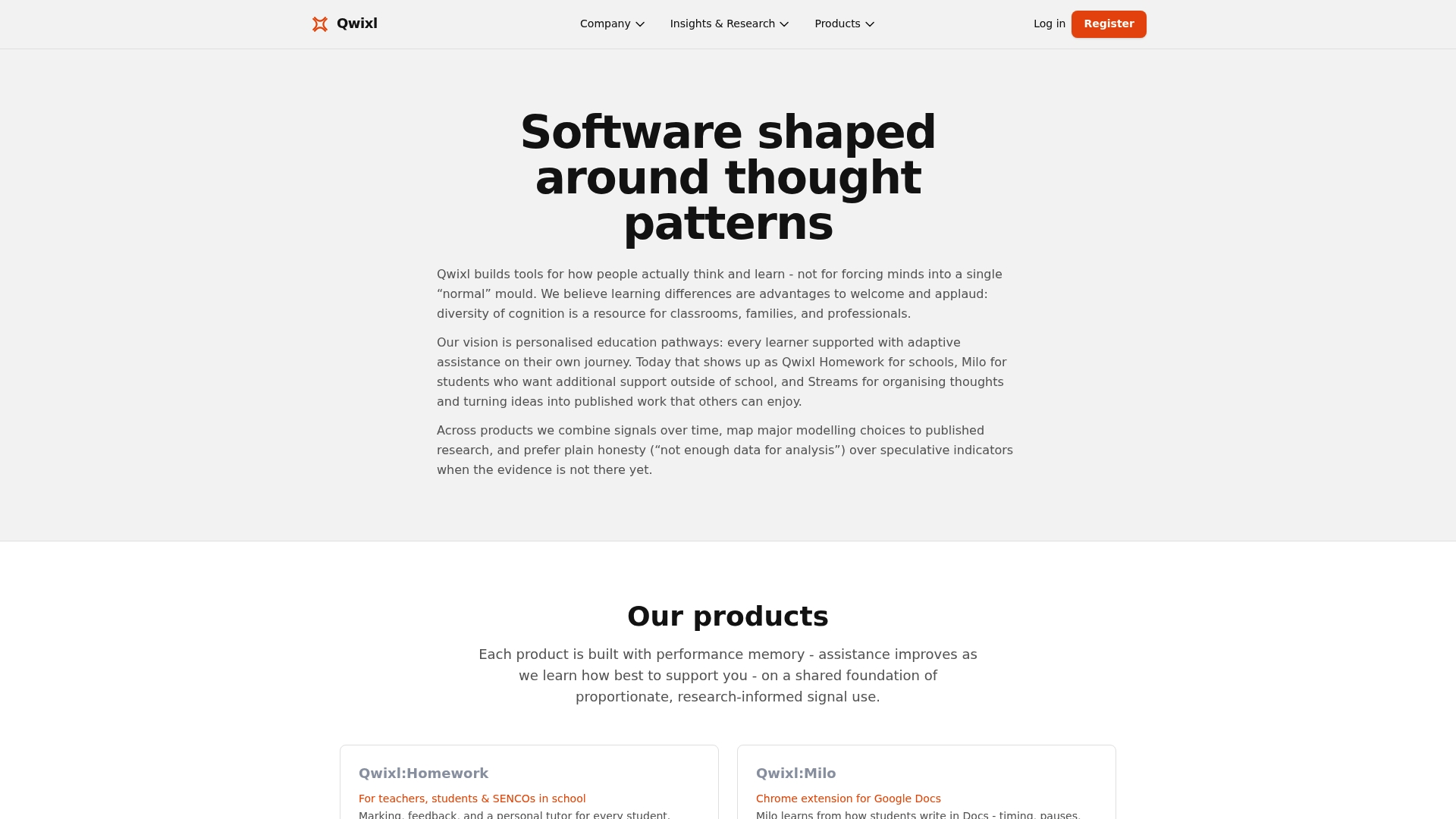
Qwixl:Homework helps teachers who take personalised homework support seriously, with AI-assisted marking and actionable feedback on written assignments. Where schools enable capture, typing-based screening signals may supplement observation (signals, not diagnoses). Qwixl:Milo offers in-context pupil-side support in Google Docs as a secondary tool. Explore pupil support plan checklists and learning support plans.
FAQ
What is a personalised learning plan for pupils?
A personalised learning plan is a structured document that aligns a pupil's current performance levels, measurable goals, instructional supports, and progress monitoring schedules to their individual academic and functional needs. For pupils with disabilities, this typically takes the form of an Individualized Education Program (IEP).
How do you write measurable goals for a personalised learning plan?
Goals must follow the SMART format: Specific, Measurable, Achievable, Relevant, and Time-bound. Each goal should state the skill, the condition under which it will be demonstrated, the mastery criterion, and the measurement tool, such as a weekly CBM probe or rubric score.
How often should progress be monitored in a personalised learning plan?
Progress monitoring should occur three to four times per year at minimum, with reports issued quarterly or alongside standard report cards. Treating monitoring as an ongoing instructional cycle, rather than an annual review, enables timely adjustments that improve pupil outcomes.
What role does UDL play in designing personalised learning plans?
The Universal Design for Learning framework from CAST provides a structure for building flexible goals, materials, and assessments that address learner variability from the outset. Applying UDL at the design stage reduces the need for individual accommodations to be added later and supports equitable access for all pupils.
Can AI tools replace teacher judgment in personalised learning plans?
AI tools can profile learners, sequence content, and aggregate progress data with measurable accuracy, but they cannot replace educator judgment. KnowledgeWorks' 2026 research is explicit that human-centered design, supported by AI rather than replaced by it, produces the most effective personalised learning outcomes.
Sources and further reading
- SEND Code of Practice: 0 to 25 years (England)
- EEF SEND in Mainstream Schools
- EEF Teaching and Learning Toolkit: Feedback
- CAST, UDL Principles and Framework for Practice