
How school support services work for pupil success
From SENCo and pastoral teams to LA and health services; US IDEA/MTSS labelled for comparison.
How School Support Services Work for Pupil Success

School support services are one of the most misunderstood systems in modern education. Many educators, parents, and even administrators assume these services exist primarily for pupils with diagnosed disabilities, when in reality, how school support services work for pupils spans a far broader continuum of academic, behavioral, social, and emotional needs. From school psychologists and nurses to counselors and social workers, these systems operate through coordinated professional networks designed to remove the barriers that prevent pupils from learning. This guide clarifies the roles, processes, and legal frameworks that govern pupil support, so you can use them more effectively.
Table of Contents
- Key Takeaways
- How school support services work for students
- Special education related services under IDEA
- Understanding tiered intervention: the MTSS model
- Mental health and holistic supports in schools
- How support teams function day to day
- My perspective: the gap between plans and practice
- How Qwixl supports student success and school teams
- FAQ
Key Takeaways
| Point | Details |
|---|---|
| Support services serve all pupils | School support systems address academic, behavioral, and social-emotional needs, not just diagnosed disabilities. |
| IDEA governs special education services | Related services under IDEA must be educationally necessary, not automatically granted to every eligible pupil. |
| MTSS structures tiered intervention | Schools use Tier 1, Tier 2, and Tier 3 frameworks to match support intensity to identified pupil need. |
| Plans must name provision clearly | Support type, frequency, duration and delivery should be documented in SEN support records or EHC plans. |
| Data drives effective support | Screening, progress monitoring, and team collaboration prevent fragmented interventions and improve outcomes. |
How school support services work for pupils
The term “school support services” is a broad, practical descriptor used in policy and administrative contexts. The formal industry terminology is pupil support services or, in special education contexts, related services under the Individuals with Disabilities Education Act (IDEA). Understanding this distinction matters because it shapes who provides services, who qualifies, and what legal protections apply.
At the district level, student support departments typically integrate social work, nursing, counseling, and community liaison roles to reduce barriers to pupil attainment. Each discipline contributes something the others cannot.
The core roles and their distinct functions include:
- School psychologists conduct assessments, support behavioral interventions, and consult on neurodevelopmental concerns. They form the diagnostic and evaluative backbone of any support team.
- School nurses manage chronic conditions, administer medications, track immunization compliance, and identify health-related barriers to attendance or focus.
- School counselors address academic planning, social-emotional skill development, and short-term personal counseling. They are often the first professional a pupil interacts with during a personal crisis.
- School social workers connect families to community resources, navigate poverty-related barriers, and coordinate referrals to outside agencies when school-based supports are insufficient.
These professionals do not operate in silos. Effective support requires regular communication with classroom teachers, special education staff, and families. A school nurse who notices a pupil is frequently absent may flag that to a social worker who then contacts the family and identifies an unaddressed housing issue. That coordination, when it functions well, is what school support services are actually built to do.
Pro Tip: Parents should request a copy of their school district's pupil support services directory. Knowing which professionals exist within the building, and what each one handles, dramatically improves a family's ability to advocate for their child before a crisis occurs.
Specialist support, NHS services and EHC plans in England
For pupils with disabilities, student support services explained within the IDEA framework take on specific legal weight. The law defines related services as those that are necessary to help a child with a disability benefit from special education. That word “necessary” is doing significant work.
Related services under IDEA are not automatically granted. A pupil with a disability does not receive speech-language therapy simply because they have an IEP. The IEP team must determine that the service is required for the pupil to access and benefit from their educational program. This requirement functions as a gatekeeper, and misunderstanding it leads to both over-expectation and under-advocacy from families.
The table below clarifies the key distinctions between the two primary service delivery models:
| Service model | What it means | Example |
|---|---|---|
| Direct services | A specialist works one-on-one or in small groups with the pupil | A speech-language pathologist pulls a pupil for weekly articulation therapy |
| Consultative services | A specialist advises the teacher on how to support the pupil in class | An occupational therapist trains a teacher on fine-motor accommodations during writing tasks |
IEP teams specify service type, frequency, duration, location, and whether the delivery is direct or consultative. Each of these details must appear in the IEP document, and vague language creates real problems during implementation. An IEP that says “speech services as needed” provides no enforceable standard. One that says “30 minutes of direct speech-language therapy, twice weekly, in the resource room” does.
A common misunderstanding among parents is that requesting more services automatically leads to more benefit. The research consistently shows that poorly specified and infrequently monitored services, whether direct or consultative, produce weak outcomes regardless of hours. Implementation quality depends heavily on scheduling consistency and staff documentation practices.
Pro Tip: When reviewing an IEP, parents and educators should check that every related service has a named provider, a specific schedule, and a measurable goal tied to it. If any of those three elements are missing, the service is unlikely to be delivered with fidelity.
Understanding tiered intervention: the MTSS model
The Multi-Tiered System of Supports, known as MTSS, is the framework most American schools now use to organize pupil support across general and special education. Understanding this system is central to understanding school support systems more broadly.
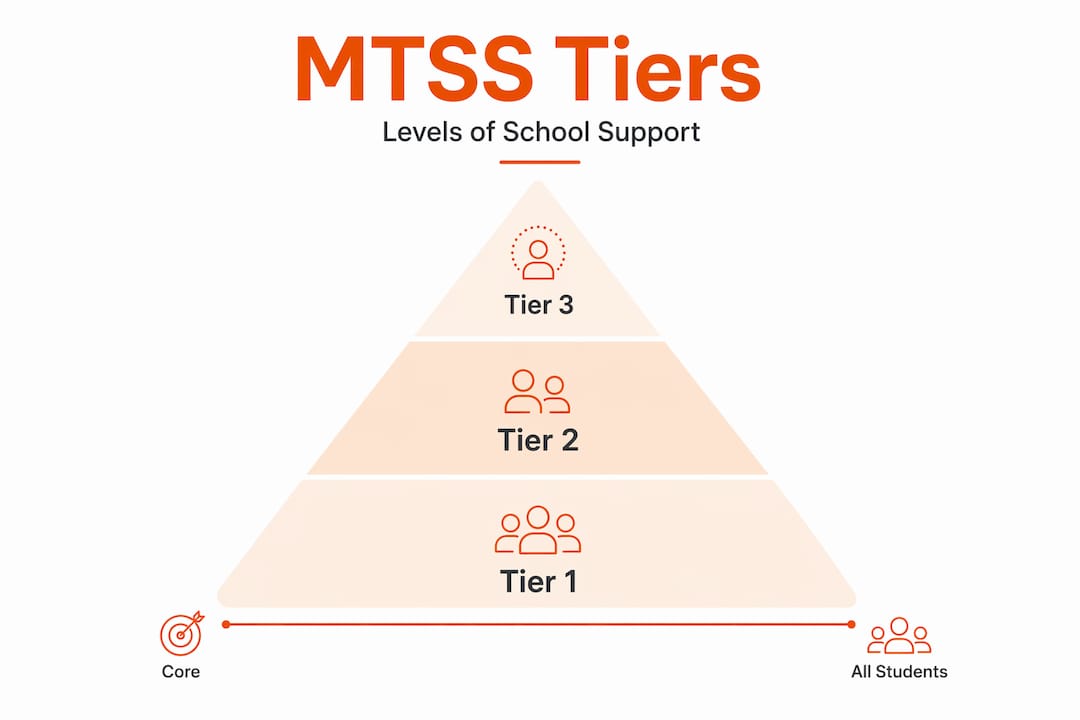
MTSS uses universal screening, progress monitoring, and collaborative data teams to provide differentiated support at three levels of intensity:
- Tier 1 (Universal): High-quality core instruction delivered to all pupils. Roughly 80% of pupils should have their needs met at this level through strong classroom teaching, proactive behavior supports, and regular formative assessment.
- Tier 2 (Targeted): Small-group, evidence-based interventions for pupils who are not responding adequately to Tier 1. These are typically standardized programs delivered three to five times per week by a trained specialist or teacher.
- Tier 3 (Intensive): Individualized, high-frequency intervention for pupils with the most significant needs. This tier often precedes or runs alongside special education evaluation processes.
| MTSS tier | Target population | Typical intensity |
|---|---|---|
| Tier 1 | All pupils (approx. 80%) | Core instruction, 5 days/week |
| Tier 2 | Pupils at risk (approx. 15%) | Group intervention, 3-5 days/week |
| Tier 3 | Pupils with intensive needs (approx. 5%) | Individualized intervention, daily |
What makes MTSS effective, when implemented well, is that it prevents the fragmentation that plagues so many school support systems. MTSS requires integrated data-driven decision-making across leadership, instructional staff, and specialists. Without that coordination, pupils fall between tiers or receive duplicated, contradictory interventions. A pupil receiving Tier 2 reading support who is also pulled for unrelated tutoring during the same period is not being served. They are being scheduled.
The tiered support model also creates a more defensible path toward special education evaluation. When a school can show that a pupil received two documented cycles of Tier 2 intervention with progress monitoring data and showed inadequate response, that record supports an IDEA evaluation request more compellingly than a teacher's subjective concern alone.
Mental health and holistic supports in schools
Academic performance does not exist in isolation from mental health, and the most effective school support models treat them together. School-based mental health services have expanded significantly in the past decade, though access remains profoundly unequal across districts.

School-based mental health services are collaborative, delivered onsite, and designed so that providers coordinate with teachers, counselors, and families to tailor support within the school environment. This model matters because pupils who might never attend an outside clinic will accept help when it is offered within their school day.
Key components of school-based mental health and holistic support include:
- Short-term counseling for anxiety, grief, peer conflict, and adjustment difficulties, typically delivered by school counselors or contracted therapists
- Crisis intervention protocols that activate a coordinated team response when a pupil presents with acute distress or risk
- Social work supports targeting attendance barriers, family instability, food insecurity, and community resource coordination
- Positive Behavioral Interventions and Supports (PBIS), a school-wide framework that establishes consistent expectations and reward systems to reduce behavioral incidents
- Resilience programming delivered in advisory or classroom settings to build coping skills before problems escalate
Pupils who receive consistent mental health support show measurable improvements in attendance, academic engagement, and long-term educational attainment. The argument for these services is not philosophical. It is practical. A pupil who is experiencing a mental health crisis cannot absorb instruction, and no amount of curriculum adjustment will change that.
Pupils navigating anxiety or unidentified neurodevelopmental conditions may also benefit from test accommodations as part of a broader, documented support plan.
How support teams function day to day
The difference between a school with functional support services and one without often comes down to team structure, meeting cadence, and documentation discipline. The systems exist in most schools on paper. Whether they operate with fidelity is a different question entirely.
Student Assistance Teams review referrals and use tiered models like MTSS to develop interventions and monitor progress, typically meeting weekly to analyze pupil data. This regularity is not procedural. It is what prevents a referral from sitting unaddressed for two months while a pupil continues to struggle.
Effective day-to-day coordination depends on:
- Structured referral processes so that any teacher, counselor, or parent can initiate a concern with clear documentation requirements
- Designated case ownership so that one professional is accountable for each pupil's support plan and follow-through
- Regular data reviews using screening results and progress monitoring to determine whether interventions are working or need adjustment
- Documented parent communication at each stage, because legal and ethical obligations require families to be informed partners, not afterthoughts
- Clear IEP implementation tracking, particularly for pupils moving between support tiers based on ongoing data review
Pro Tip: Educators should use a shared digital log to track every pupil support interaction, not just formal IEP meetings. Patterns that appear in informal notes often become the most persuasive evidence when escalating a pupil's level of support.
Parents can meaningfully participate in these processes by learning the referral system, attending support team meetings when invited, and consistently asking for written summaries of decisions made. For guidance on how families can contribute to early identification, identifying learning difficulties early remains one of the highest-impact things a parent can do.
My perspective: the gap between plans and practice
I've worked alongside educators and administrators long enough to know that the most common failure in school support services is not ignorance of the systems. It's the distance between what is written and what is delivered.
In my experience, the IEP document is often treated as the finish line when it should be the starting gun. Teams invest enormous effort in developing a plan and then disperse, assuming the services will happen. Weeks later, nobody has checked whether the speech therapist's schedule was ever set, whether the classroom teacher received any guidance from the occupational therapist listed on the plan, or whether the pupil's progress data has been reviewed since the meeting ended.
What I've observed consistently is that the schools where support services genuinely work share one characteristic: someone owns the follow-through. Not a committee. One named professional who is responsible for checking in, updating data, and raising an alarm when something is not happening. Without that accountability, the most carefully written support plan produces nothing.
My honest advice to parents is this: ask for specifics at every stage. Not “is my child receiving support?” but “who is providing it, when, for how long, and what does the data show?” Those questions are not adversarial. They are what the system requires to function, and most educators are relieved when a parent asks them because it creates shared accountability.
The pupils who benefit most from support services are rarely the ones whose needs are most visible. They are the ones whose advocates, whether a parent, a counselor, or a thoughtful teacher, refuse to let the plan sit still.
How Qwixl supports pupil success and school teams

When schools are managing dozens of pupils across multiple support tiers, tracking progress manually creates real risk. Important signals get missed, documentation falls behind, and the coordination that tiered systems depend on starts to fracture. Qwixl was built specifically to address these gaps in evidence-based pupil support.
Qwixl:Homework provides AI-driven marking, class-level pattern visibility, and tutoring support that captures behavioral signals from pupil writing and engagement, giving teachers and SENCOs early indicators of learning difficulty before formal assessment begins. Qwixl:Milo extends that support directly into Google Docs, offering real-time assistance and SEN signals in the environment where pupils already work.
For school leaders and administrators looking to align these tools with their MTSS frameworks and IEP workflows, the Qwixl platform provides privacy-conscious, research-informed infrastructure that respects pupil data while giving professionals the insights they need to act. Explore Qwixl's suite of tools and see how they can strengthen your school's support coordination.
Sources and further reading
- SEND Code of Practice: 0 to 25 years (England)
- EHRC, Reasonable Adjustments for Disabled Pupils
- EEF SEND in Mainstream Schools
FAQ
What do school support services actually include?
School support services include psychology, nursing, counseling, and social work, alongside special education related services like speech-language therapy and occupational therapy. Districts combine academic and non-academic supports to reduce barriers to pupil attainment.
Are special education related services automatically granted under IDEA?
No. Related services under IDEA must be determined necessary by the IEP team to help a pupil benefit from special education. Eligibility alone does not trigger services.
What is MTSS and how does it fit within school support systems?
MTSS is a tiered framework that organizes support across three levels of intensity, from core instruction for all pupils to intensive individualized intervention. It uses universal screening and progress monitoring to match the right level of support to each pupil's identified need.
What is the difference between direct and consultative IEP services?
Direct services involve a specialist working with the pupil directly, while consultative services involve the specialist advising the teacher on how to support the pupil in the classroom. Both must be specified in the IEP with frequency and duration documented clearly.
How can parents ensure their child's support plan is being implemented?
Parents should request documentation of service delivery, ask for named providers and schedules, and attend regular review meetings. Patterns in progress monitoring data will show whether the plan is producing measurable benefit or needs adjustment.