
What is educational equity in schools? 2026 guide
Equity as removing barriers, not lowering expectations; evidence-led classroom practice.
What Is Educational Equity in Schools? 2026 Guide

Educational equity in schools is one of the most debated and most misunderstood concepts in contemporary education policy. While many educators and parents use “equity” and “equality” interchangeably, these terms describe fundamentally different approaches to pupil support, and confusing them leads to real harm for real pupils. Understanding what is educational equity in schools means grasping why identical treatment often produces unequal outcomes, and why some pupils need tailored resources to reach the same standards as their peers. This guide covers the definition, the evidence, the obstacles, and the strategies that educators, policymakers, and parents need to drive meaningful change.
Table of Contents
- Key takeaways
- What is educational equity in schools
- Why educational equity matters
- Challenges to educational equity in schools
- Strategies to achieve educational equity
- Applying equity principles in practice
- My perspective on what equity really demands
- How Qwixl supports equity in your school
- FAQ
Key takeaways
| Point | Details |
|---|---|
| Equity differs from equality | Equity provides resources based on individual need; equality distributes the same resources to everyone regardless of circumstance. |
| Systemic barriers require active removal | Funding gaps, biased curricula, and lack of qualified teachers prevent equitable outcomes without deliberate policy intervention. |
| Equity benefits the whole system | Equitable schools produce better social mobility, stronger civic participation, and reduced long-term economic costs for society. |
| Data identifies opportunity gaps | Schools that track outcomes by pupil subgroup can pinpoint and address disparities before they compound over time. |
| Technology can level access | Tools designed for personalised and SEN-informed learning help identify barriers that classroom observation alone often misses. |
What is educational equity in schools
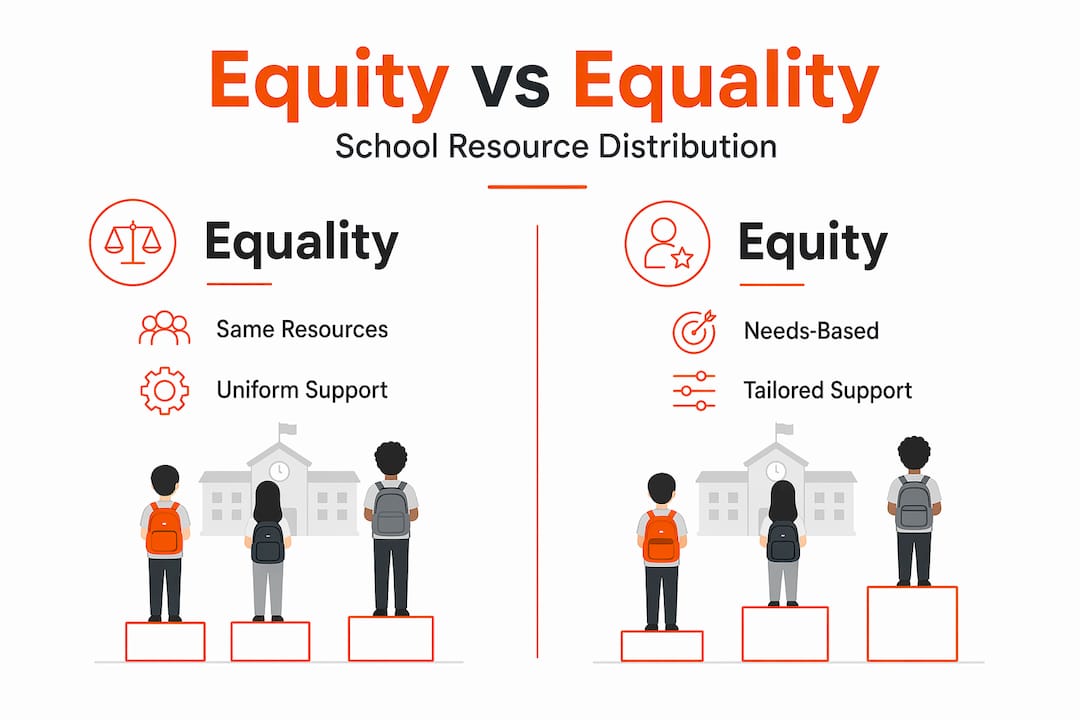
The most precise educational equity definition frames it as the practice of allocating resources, supports, and opportunities based on what each pupil actually needs, rather than distributing identical inputs regardless of circumstance. Equity focuses on individual-level allocation, such as specialized tutoring, multilingual materials, and assistive technology, to overcome the systemic barriers that prevent some pupils from achieving the same outcomes as their peers.
Educational equality in schools, by contrast, assumes a level playing field that does not exist. Giving every pupil the same textbook, the same amount of instructional time, and the same standardized test ignores the reality that a pupil managing food insecurity, a pupil with dyslexia, and a pupil with highly educated parents at home are not starting from the same position. Equality treats them identically. Equity acknowledges the gap and responds deliberately.
The table below captures the core distinction:
| Dimension | Educational equality | Educational equity |
|---|---|---|
| Resource distribution | Same resources for all pupils | Resources proportional to pupil need |
| Assumptions | Pupils start from the same baseline | Pupils face different barriers and starting points |
| Goal | Equal inputs | Equal opportunity and comparable outcomes |
| Example | One curriculum for every learner | Bilingual materials, SEN accommodations, mentorship programs |
Understanding equity in education also means recognizing that equity is not permanent favoritism. It is responsive: once a barrier is removed, the level of additional support can change. A pupil who receives intensive reading intervention in second grade should not require the same intensity in fifth grade if the gap has closed. That flexibility is what separates equity from blanket resource redistribution.
Key markers of an equity-informed school include:
- Differentiated instruction aligned with assessed learning profiles
- Transparent tracking of academic outcomes disaggregated by race, income, disability, and language background
- Staffing policies that direct experienced teachers to schools and classrooms with the highest need
- Admissions and discipline practices reviewed for structural bias
Why educational equity matters
The case for equity extends well beyond individual classrooms. Equitable systems reduce social costs from attainment gaps, support long-term social mobility, and sustain the civic foundations of a functional democracy. When pupils from low-income families, pupils with disabilities, or pupils who are learning English as a second language fail to reach their potential, the consequences ripple outward into communities, labor markets, and public institutions for decades.
“Equity's true goal is preparing equitable citizens capable of active democratic participation.” Doug Selwyn, 2025
The economic argument is direct. Pupils who leave school without foundational skills are more likely to experience unemployment, lower lifetime earnings, and poorer health outcomes. Entire communities absorb those costs through increased demand on social services and reduced tax bases. Investing in equity earlier is not charity. It is fiscally sound policy.
The democratic argument is equally compelling. Schools that produce engaged, informed graduates who understand their rights and responsibilities underpin civic life. When systematic educational disparities in schools leave entire demographic groups without those capacities, democracy weakens structurally. Schools must value each child equally, supporting civic participation regardless of starting point.
The benefits of educational equity also include:
- Narrowed attainment gaps between demographic groups over time
- Reduced rates of school dropout, disciplinary exclusion, and grade repetition
- Stronger teacher retention when schools have shared equity goals and adequate resources
- Greater parental trust and community investment in public education
Pro Tip: When making the case for equity to school boards or community stakeholders, lean on the economic data first. Arguments grounded in long-term cost reduction and workforce readiness tend to move political conversations faster than philosophical appeals alone.
Challenges to educational equity in schools

Identifying what gets in the way is as important as defining the goal. The challenges of educational equity operate at multiple levels simultaneously, and addressing only one while ignoring the others produces limited, unsustainable results.
Funding structures are among the most persistent obstacles. In many states, school budgets are tied primarily to local property taxes, which means wealthy districts receive substantially more per-pupil funding than low-income ones. This structural imbalance affects building infrastructure, technology access, extracurricular programs, and the ability to attract and retain qualified staff. No amount of equity-focused classroom practice fully compensates for a school that simply has fewer resources to work with.
Curriculum bias is a subtler but equally serious barrier. When instructional materials reflect only the experiences and histories of dominant cultural groups, pupils from marginalized communities receive an implicit message that their identities and contributions are peripheral. This affects engagement, belonging, and academic performance in ways that assessments rarely capture cleanly.
Pupils with undiagnosed special educational needs face a compounding disadvantage: they experience learning barriers that are invisible to the system until they accumulate into failure. By the time a neurodevelopmental condition is formally identified, a pupil may have spent years interpreting their own struggles as personal inadequacy rather than a systemic failure to provide appropriate support.
Equity requires dismantling structural barriers unique to marginalized groups, and that demands focused leadership. Too many schools respond to equity demands with surface-level diversity training that leaves funding models, discipline practices, and assessment systems untouched. Surface-level training frustrates staff and fails pupils. Structural change is the only mechanism for sustainable progress.
Resistance from within school communities also slows progress. Equity is often misread as lowering standards or redirecting resources away from high-achieving pupils. That framing is factually incorrect. Equity aims to remove barriers so that all pupils can meet high standards, not to reduce expectations for anyone.
Strategies to achieve educational equity
Moving from diagnosis to action requires both policy-level commitments and classroom-level practice. The following sequence reflects how equity-focused schools tend to approach implementation systematically.
- Define equity locally and transparently. Abstract equity definitions create confusion and reduce accountability. School leaders who work with staff, families, and pupils to develop a shared, specific definition see stronger buy-in and more consistent implementation.
- Audit resource allocation by pupil need. Map which pupils are receiving additional support, which are not, and whether the distribution correlates with documented barriers rather than teacher preference or administrative convenience.
- Implement culturally responsive teaching practices. Train teachers to design lessons that reflect diverse cultural contexts and prior knowledge, and assess whether all pupils can access the curriculum as written.
- Disaggregate outcome data by pupil subgroup. Schools that report outcomes by subgroup and track them over time can identify which pupils are falling behind before those patterns become entrenched.
- Build restorative rather than punitive discipline systems. Discipline practices that disproportionately remove pupils of color, pupils with disabilities, or pupils from low-income families from instructional time compound existing educational disparities in schools.
- Engage families and communities as partners. Equity initiatives that exclude the communities they are designed to serve tend to misidentify both the barriers and the solutions.
Pro Tip: Use evidence-based student support practices rather than relying on institutional habit when selecting interventions. Research consistently shows that targeted, low-inference feedback outperforms generalized encouragement for pupils who are behind grade level.
The table below illustrates how specific equity strategies map to the barriers they address:
| Barrier | Strategy | Measurable indicator |
|---|---|---|
| Funding gaps | Weighted per-pupil funding formulas | Per-pupil spending parity across schools |
| Curriculum bias | Culturally responsive materials review | Pupil belonging surveys by demographic group |
| Unidentified SEN | Screening tools and early intervention | Time from concern raised to support in place |
| Punitive discipline | Restorative justice programs | Suspension rates by demographic subgroup |
| Teacher quality gap | Incentivized staffing in high-need schools | Teacher retention rates in underserved schools |
Applying equity principles in practice
Translating equity from policy language into daily classroom practice requires a different kind of discipline from educators and parents alike. The gap between a district's equity statement and what pupils actually experience in a classroom is often wide, and closing it requires deliberate, observable actions.
How feedback improves learning outcomes is a useful lens here. Equitable assessment is not the same as easy assessment. It means designing tasks that allow pupils with different learning profiles to demonstrate mastery, and providing feedback that is specific enough to be used. Generic comments like “good effort” do not reduce gaps. Feedback tied directly to a pupil's specific misconception does.
Practical steps educators can take include:
- Conducting brief, low-stakes diagnostic checks at the start of each unit to identify which pupils are missing prerequisite knowledge before instruction begins
- Designing multiple means of expressing understanding: oral, written, visual, and practical modes allow pupils with language barriers or motor difficulties to show what they actually know
- Creating psychologically safe classroom environments where asking questions is normalized, since pupils who fear judgment suppress confusion rather than resolving it
- Partnering with SENCOs and family members to share what is observed in classroom behavior, since a pattern noticed at home often confirms a concern developing at school
Pro Tip: When reviewing pupil data to identify opportunity gaps, look at trend lines across at least three assessment points rather than single snapshots. A pupil who scored poorly once may be having a bad week. A pupil who has declined across three consecutive assessments is showing a pattern that warrants a conversation.
Families play a substantial role that schools often underutilize. Parents who understand their child's learning profile and know what support the school is providing can reinforce approaches at home, advocate more precisely during meetings, and identify behavioral changes that signal something is not working. Personalised homework support structures that keep families informed create a feedback loop that classroom observation alone cannot replicate.
My perspective on what equity really demands
I've spent years watching equity initiatives arrive with genuine energy and then stall, and the pattern is almost always the same. The problem is rarely commitment. It is almost always the gap between what gets announced and what gets resourced.
What I've learned is that equity requires schools to be honest about discomfort. When you disaggregate outcome data and see that pupils from one demographic group are consistently receiving less effective instruction, that is not a neutral finding you can address with a workshop. It requires a structural response that may be politically inconvenient. The schools that sustain equity progress are the ones willing to have that conversation publicly and follow it with a budget line.
I also think the framing of equity as a threat to high achievers is one of the most damaging misconceptions in education today. Inclusion and excellence are not trade-offs. Every serious body of research on this topic points in the same direction: removing barriers for struggling pupils does not reduce the ceiling for advanced ones. It creates a more skilled, more cohesive learning environment that benefits everyone in the room.
The hardest part of equity work is sustaining it when political winds shift. My honest advice: ground your school's equity goals in specific, local data, define success in measurable terms, and build accountability structures that outlast any individual leader's tenure. That is the only version of equity that actually reaches pupils.
How Qwixl supports equity in your school

Identifying which pupils need additional support is one of the central challenges of educational equity in schools, and it is exactly the problem Qwixl is built to address. Qwixl's tools capture signals from pupil writing, typing patterns, and engagement behaviors to surface learning barriers that standard assessment often misses, particularly for pupils with undiagnosed neurodevelopmental conditions. Rather than waiting for a pupil to accumulate enough failures to qualify for formal assessment, Qwixl:Homework provides educators and parents with research-informed insights that allow earlier, more targeted intervention. For schools committed to how to achieve educational equity, Qwixl offers a privacy-conscious, evidence-based layer of support that makes equity principles operational rather than aspirational. Explore how Qwixl can support your pupils today.
FAQ
What is the difference between equity and equality in schools?
Educational equality gives every pupil the same resources, while educational equity allocates resources based on individual need. Equity recognizes that pupils face different barriers and adjusts support accordingly to produce comparable outcomes.
Why is educational equity important?
Equitable education promotes social mobility, reduces long-term social costs from attainment gaps, and supports democratic citizenship. Pupils who receive appropriate support are more likely to complete school, participate in civic life, and contribute economically.
What are the main challenges of educational equity?
The core challenges include inequitable school funding tied to local property taxes, curriculum bias, under-identification of pupils with special educational needs and disabilities, punitive discipline practices, and resistance to structural reform within school systems.
How can educators promote equity in their classrooms?
Educators can promote equity by using diagnostic assessments to identify prerequisite gaps before instruction, designing multiple modes of assessment, tracking outcomes by pupil subgroup, and collaborating with families and SENCOs to share observations about individual learning behaviors.
Does equity lower standards for high-achieving pupils?
No. Equity aims to remove barriers so all pupils meet high standards, not to reduce expectations for advanced learners. Research consistently shows that inclusive, equity-focused environments raise outcomes across all pupil groups.
Sources and further reading
- SEND Code of Practice: 0 to 25 years (England)
- EHRC, Reasonable Adjustments for Disabled Pupils
- EEF SEND in Mainstream Schools