
Formative assessment: a complete guide for teachers
What formative assessment is, what EEF research suggests about feedback timing and impact, and how to use assignment evidence in class.
Formative assessment: a complete guide for teachers

Formative assessment is one of the most consequential practices available in a classroom, yet it is also widely misunderstood. Many educators still conflate it with quizzes, grades or end-of-unit tests, when the formative role is to shape instruction as learning unfolds, not to evaluate it after the fact. This guide clarifies that distinction, summarises what Black and Wiliam (1998) and the Education Endowment Foundation (EEF) say about why it can work, and offers practical strategies for using classroom formative evaluation to support diverse learners, including pupils with special educational needs and disabilities (SEND).
Table of Contents
- What is formative assessment and why does it matter?
- How formative assessment guides responsive teaching and supports diverse learners
- Key nuances and best practices in formative assessment
- Incorporating technology and new perspectives in formative assessment
- Practical steps to implement formative assessment in your classroom
- Why formative assessment mindset matters as much as tools
- How Qwixl supports formative assessment in classrooms
- Frequently asked questions
Key Takeaways
| Point | Details |
|---|---|
| Ongoing evidence gathering | Formative assessment continuously collects evidence of pupil understanding to guide instructional adjustments. |
| Timely feedback, not rigid schedules | EEF advises feedback can work during, immediately after or some time after learning; policies should not over-specify frequency. |
| Supports differentiated teaching | Formative data can help tailor instruction through flexible grouping and targeted reteaching. |
| Focus on learning process | Modern formative practice often emphasises reasoning and decision-making, not only final products. |
| Teacher responsiveness is key | Using evidence to adjust teaching usually matters more than which specific tool is selected. |
What is formative assessment and why does it matter?
Black and Wiliam (1998) define formative assessment as ongoing assessment used during learning to gather evidence about pupils' understanding and inform teaching, not to grade or rank. That definition separates it from nearly every other assessment type teachers use. It is not a quiz with a grade attached. It is not a standardised measure that produces a score weeks later. It is the continuous act of reading where pupils are in their learning and responding instructionally before gaps widen.
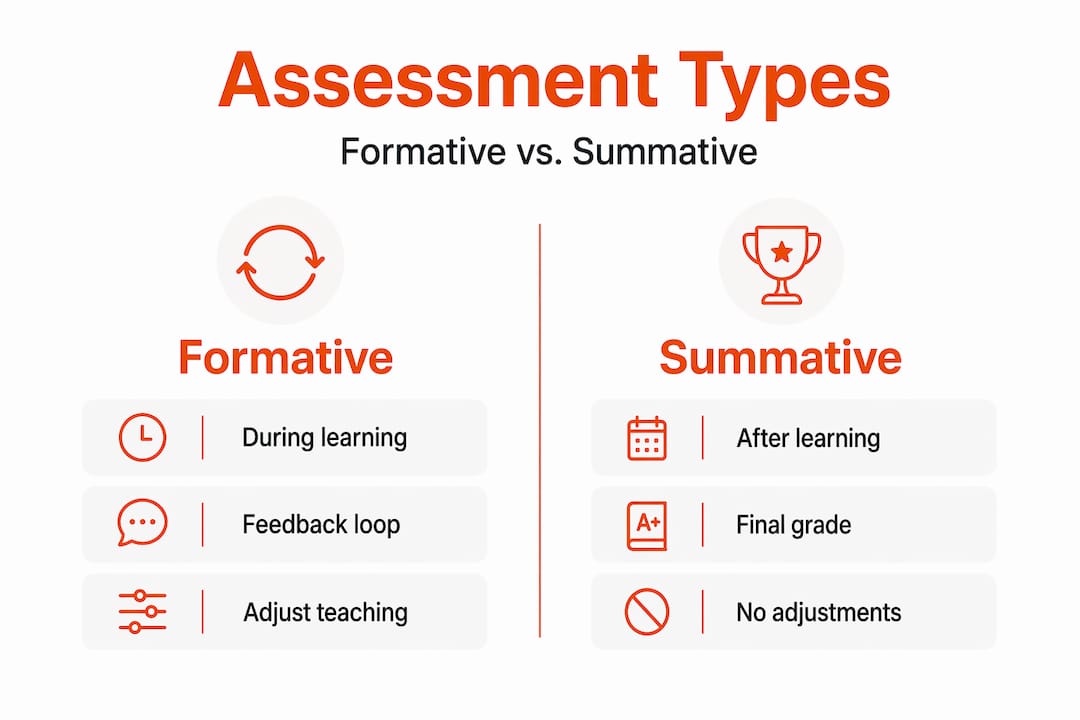
The distinction between formative and summative assessment is worth stating precisely because confusion between them is common and costly.
| Feature | Formative assessment | Summative assessment |
|---|---|---|
| Timing | During learning | After learning |
| Stakes | Low or no stakes | High stakes |
| Purpose | Adjust instruction | Evaluate achievement |
| Feedback | Often immediate and actionable | Delayed and evaluative |
| Impact on grades | Typically none | Primary grade input |
| Pupil role | Active participant | Test taker |
The importance of classroom assessment done formatively goes beyond measurement. When pupils receive low-stakes, specific feedback on their thinking while they are still learning, they may be more willing to take intellectual risks because the feedback carries no punitive consequence. They may also develop self-regulation skills that help them monitor their own progress. The role of assessment in learning, when practised formatively, is not to sort or rank pupils but to inform and improve the teaching happening now.
How formative assessment guides responsive teaching and supports diverse learners
The impact of formative assessment is most visible when teachers act on evidence during or soon after instruction. That requires a shift in how lessons are structured. A teacher who delivers a fixed plan regardless of what pupils demonstrate is not practising formative assessment, even if they collect exit tickets at the door. Formative assessment can support differentiated instruction and intervention planning when evidence is used intentionally, as the EEF Embedding Formative Assessment programme illustrates.

For pupils with diverse learning needs, formative practice can be particularly useful. Varied readiness levels within a single class, which is the norm in most schools, demand that teachers identify where each pupil actually is, not only where the curriculum assumes they should be. Formative data can make that visible when combined with professional judgement, as EEF SEND guidance emphasises.
Key ways formative assessment can support diverse learners include:
- Real-time pivoting. If many pupils give incorrect responses to the same question, a teacher can pause, reteach and reframe before moving forward, rather than discovering the gap on a unit test weeks later.
- Targeted small-group instruction. Formative data can reveal clusters of pupils sharing similar misconceptions, allowing focused reteaching rather than repeating content to the whole class.
- Personalised scaffolding. Pupils who demonstrate early mastery can move toward extension tasks while others receive additional modelling, without visible permanent ability grouping.
- Pupil ownership. When learning goals are shared openly and progress is made visible through formative check-ins, pupils can better understand what they know, what they do not know and what to do next.
Assignment-centred platforms such as Qwixl:Homework can help teachers gather written responses and feedback patterns across a class without adding polling-style classroom tools. Where schools enable capture, typing-based signals from homework submissions may supplement teacher observation (screening signals, not diagnoses). See our article on teacher workload and support tools for how feedback workload fits wider staff wellbeing.
Pro Tip: Do not wait for a formal check-in to gather formative data. A brief two-minute discussion at the start of class, where pupils explain a concept to a peer before instruction begins, can reveal more about prior understanding than some formal pre-assessments.
Key nuances and best practices in formative assessment
Knowing what formative assessment is matters less than knowing how to use it well. Several nuances separate teachers who collect formative data from those who use it to change outcomes.
-
Act on evidence while it is still useful. The EEF Feedback Toolkit notes that feedback can be effective during, immediately after or some time after learning, and that feedback policies should not over-specify frequency. Short-cycle classroom checks often warrant a response in the next lesson; longer written assignments may need a different rhythm. The key is connecting evidence to a concrete instructional change, not waiting until a distant planning slot when the moment has passed.
-
Group by misconception, not ability. When formative data reveals that a subset of pupils misunderstands a specific concept, grouping those pupils for targeted reteaching is often more productive than sorting by general performance level.
-
Use pupil self-reflection deliberately. Confidence scales, where pupils rate their understanding before and after a task, can help distinguish pupils who lack understanding from pupils who understand content but lack confidence to demonstrate it. Self-ratings are imprecise and should not replace teacher assessment.
-
Avoid grading formative work. When a formative task carries a grade, its diagnostic value often collapses. Pupils shift from demonstrating genuine understanding to performing for a score. Rich formative data often comes from informal observations, brief verbal exchanges and low-stakes written responses.
Some pupils, including those with identified SEND, may find evaluative tasks harder under mild pressure. The SEND Code of Practice is clear that schools must not assume a diagnosis is required before putting support in place. Formative evidence should inform the graduated approach, not substitute for statutory assessment processes.
Pro Tip: Ask pupils to submit a "muddiest point" at the end of class: one sentence describing the concept they find most unclear. This takes under three minutes to collect and gives a precise map of where to start the next lesson.
Incorporating technology and new perspectives in formative assessment
Generative AI tools are reframing how some teachers design formative tasks, particularly around what is being assessed. With AI increasingly capable of producing polished final products, formative practice may shift emphasis from final answers toward pupils' working processes and reasoning. That shift is still emerging rather than settled.
When pupils compare their own reasoning with an AI-generated output, they may engage in metacognitive analysis that formative techniques aim to support. The process can become part of the assessment, not only the product.
Consider how digital tools can support formative practice without replacing teacher judgement:
- Assignment-level response patterns. Homework platforms can aggregate written responses from an entire class, surfacing shared misconceptions from short explanations or worked answers rather than live classroom polls.
- Process visibility. Digital writing and assignment tools can show how a pupil worked through a problem, which may reveal engagement patterns that a final answer alone obscures.
- Faster feedback loops. AI-assisted draft feedback on homework submissions can reach pupils sooner than manual marking alone in larger classes, though the EEF notes digital feedback averages about four months' additional progress versus about six months overall for feedback approaches.
- Varied formats. Technology-mediated feedback can be delivered in different formats and pacing, which some pupils with dyslexia, ADHD or processing differences may find helpful alongside reasonable adjustments.
| Assessment focus | Traditional approach | Assignment-centred digital approach |
|---|---|---|
| What is assessed | Final answer or product | Process, reasoning and misconceptions in written work |
| Feedback timing | End of task or next lesson | During drafting or soon after submission |
| Data granularity | General impression | Class-wide patterns from homework responses |
| SEND context | Teacher-dependent | Supplements observation; not a diagnosis tool |
Qwixl:Homework is designed around assignment feedback and class-level pattern visibility for teachers and SENCos, not classroom polling or clicker-style engagement. See digital tools in formative feedback for related practice ideas.
Practical steps to implement formative assessment in your classroom
Starting a formative assessment practice does not require a curriculum overhaul. It requires consistent habits, a willingness to respond to what you find, and structures that keep the feedback loop short.
- Start with one simple check per lesson. An exit ticket, a show-of-hands check or a one-sentence written response at the end of class is sufficient. The goal is frequency, not complexity.
- Use data to adjust pacing when patterns are clear. When many pupils show the same misconception, pause forward progress and revisit before introducing new material. There is no research-backed universal percentage threshold for this decision; teacher judgement and the scale of the gap matter.
- Share learning goals explicitly. Pupils who understand the specific goal of a lesson are better positioned to self-assess accurately. Vague goals produce vague self-reflection.
- Analyse class patterns weekly. Look for recurring misconceptions, not only individual errors. Patterns across a class may indicate instructional design issues; isolated errors may point to individual support needs.
- Use homework assignments for between-lesson insight. Short written tasks submitted through a homework platform can show class-wide understanding before the next lesson, making it easier to plan reteaching or extension without live polling tools.
Consistent low-stakes formative practice is associated with learning gains in research syntheses such as Black and Wiliam (1998). The EEF Embedding Formative Assessment trial found pupils in participating schools made the equivalent of about two months' additional progress in Attainment 8 GCSE scores on average, with indication that lower-attaining pupils may benefit more (though that subgroup finding is less secure). The EEF Feedback Toolkit estimates feedback can deliver around six months' additional progress on average, with low-attaining pupils tending to benefit more from explicit feedback than high attainers.
Key practices worth building into weekly routines:
- Brief peer discussion before new instruction begins
- Written reflections tied to specific learning goals, not general feelings
- Teacher observation checklists for small-group work sessions
- Targeted re-teaching in the first ten minutes of the following class when exit-ticket data warrants it
Pro Tip: Reserve the final five minutes of every class for structured reflection, not a summary. Ask pupils to write what they would explain differently, or what they would need to feel confident tomorrow. The distinction between "I understand" and "I could teach this" reveals more about actual mastery.
Why formative assessment mindset matters as much as tools
There is a version of formative assessment adoption that looks productive but accomplishes little: teachers collect data consistently, use well-designed digital tools, generate dashboards, and then teach the same lesson they planned regardless of what those dashboards show. The tools are present. The responsive mindset is absent.
Research commentary, including work by Dylan Wiliam on formative assessment implementation, suggests that teacher disposition to use evidence matters greatly. Tools alone are insufficient if formative data is treated as an administrative task rather than an instructional signal. A teacher committed to reading pupil understanding and adjusting in response may achieve strong outcomes without extensive technology; equally, technology without responsive practice is unlikely to change learning on its own. No robust head-to-head evidence supports a claim that teachers without technology consistently outperform fully tooled colleagues.
Schools often invest in assessment platforms and reporting tools. Equivalent investment in building teacher capacity to respond to what those reports reveal is where many of the learning gains are made. The most durable formative practice comes from a simple but demanding commitment: what pupils demonstrate during learning should change what happens next in instruction, ideally in the next lesson or activity. That responsiveness requires professional culture that values flexibility over rigid pacing guides.
Explore how a research-aligned approach to assignment feedback supports that kind of instructional culture through Homework, not separate polling products.
How Qwixl supports formative assessment in classrooms
Effective formative assessment depends on timely evidence, actionable feedback and the capacity to respond to diverse pupil needs without overwhelming teachers. Qwixl:Homework was built with that operational reality in mind for teachers and SENCos.
Qwixl:Homework provides AI-assisted marking and feedback on written assignments, helping teachers see class-level response patterns and return comments while keeping professional judgement central. Where schools enable capture, typing-based screening signals from homework may supplement observation (signals, not diagnoses). For pupils who write in Google Docs, Qwixl:Milo offers in-context student-side support as a secondary tool on this teacher-focused topic. Together, Homework and Milo aim to shorten the distance between evidence and action, which is where formative practice often produces its gains.
For schools seeking timelier formative insight alongside equitable workload reduction, explore Homework and our guides on setting up a homework feedback system and how feedback improves learning outcomes.
Frequently asked questions
What is the main purpose of formative assessment in the classroom?
The main purpose is to gather evidence of pupil understanding so teachers can adjust instruction. Black and Wiliam (1998) describe formative assessment as a planned, ongoing process during learning, distinct from evaluation after learning is complete.
How soon should teachers act on formative assessment data?
As soon as practicable for the type of evidence collected. The EEF cautions against rigid timing rules: feedback can be effective during, immediately after or some time after learning. Short-cycle classroom checks often need a response in the next lesson; longer assignments may follow a different rhythm.
Can technology improve formative assessment effectiveness?
Technology can support formative practice by speeding feedback and surfacing patterns from assignments. The EEF estimates digital feedback averages about four months' additional progress versus about six months overall for feedback approaches. Impact depends on how tools are integrated with responsive teaching, not on technology alone.
Does formative assessment help all students equally?
Research suggests low-attaining pupils tend to benefit more from explicit feedback than high attainers, on average. The EEF Embedding Formative Assessment trial showed about two months' additional progress overall, with indication that lower-attaining pupils may benefit more, though that subgroup finding is less secure. Equitable implementation remains important for all pupils.
Sources and further reading
- Black and Wiliam (1998), Inside the Black Box
- EEF Teaching and Learning Toolkit: Feedback
- EEF (2021), Teacher Feedback to Improve Pupil Learning
- EEF Embedding Formative Assessment
- EEF SEND in Mainstream Schools
- SEND Code of Practice 2015