
How schools balance privacy and insight in 2026
Lawful, transparent data use that supports teaching without turning analytics into surveillance.
How Schools Balance Privacy and Insight in 2026

Balancing pupil privacy with actionable educational insight means protecting personal data while using information to improve learning, governed in the UK by the UK GDPR, the Data Protection Act 2018 and ICO guidance. Schools today operate within a legal and technological environment that pre-cloud privacy rules never fully anticipated. Cloud platforms, AI-driven analytics tools, and third-party edtech vendors have expanded the data perimeter far beyond the file cabinets the law was designed to protect. Understanding how schools balance privacy and insight requires examining the legal framework, the technical controls, and the communication practices that together make responsible data use possible.
How schools balance privacy and insight under UK GDPR
UK GDPR, codified at UK GDPR, establishes the baseline rule: schools may not disclose pupil education records without written consent from a parent or eligible pupil. Where schools rely on legitimate interests, they should document why access is necessary, limit it to the specific task, and balance pupil rights carefully. This is not a blanket permission for analytics dashboards.
The practical challenge is that broad system permissions can quietly normalise excessive access. Schools that manage this well treat each data use as a discrete decision with a documented purpose.
Effective operationalization involves several concrete controls:
- Role-based access controls: Each staff member's system permissions map directly to their defined role. A counselor sees different data than a classroom teacher, and neither sees data outside their current caseload.
- Task-limited authorization: Access is granted for a specific purpose and expires when that purpose is fulfilled. A teacher reviewing a pupil's support plan for a specific accommodation decision does not retain access to that record indefinitely.
- Transparency requirements: Privacy notices and supplier information should explain what is collected, why, retention periods and who can access data. ICO Age Appropriate Design Code (Children's code) sets high expectations where services are likely to be accessed by children.
- Technical controls: Audit logs, multi-factor authentication and automated access expiry tied to role changes are baseline expectations for school systems in 2026.
- Permissible vs. impermissible scenarios: A principal reviewing attendance data to identify chronic absenteeism is permissible. A coach accessing a pupil's mental health records out of personal concern is not, regardless of good intentions.
Pro Tip: Review your privacy notice and role permissions together at least once per year. If the notice is vague while system access is broad, your governance is likely misaligned with UK GDPR expectations.
What practical steps reduce data risk through vendor management?
Privacy breaches in schools often occur during vendor selection and onboarding, making rigorous evaluation the foundation of trustworthy insight. The application approval process is not a procurement formality. It is a privacy checkpoint that determines whether a vendor's data practices are compatible with the school's legal obligations and ethical commitments.

The PowerSchool/Naviance settlement illustrates the cost of inadequate vendor scrutiny. A $17.25 million settlement resulted from unauthorized third-party tracking embedded in a widely used school platform from 2021 to 2026, with obligations to delete tracked data. The settlement demonstrates that embedded analytics code can quietly expand data exposure far beyond what any contract or privacy policy describes.
Schools that manage vendor risk effectively follow a structured approval sequence:
- Data minimization review: Before approving any integration, identify the minimum data set the vendor needs to deliver its function. Sharing a tokenized pupil identifier instead of a full name and date of birth achieves the same integration goal with a fraction of the exposure.
- Tokenized and zero-PII integrations: Tokenization at the system-connection layer protects privacy and enables scalable governance during app integrations. Zero-PII integrations limit data exposure to functional identifiers only, with no personally identifiable attributes transmitted.
- SOC 2 audit verification: AASA's pupil data privacy guidance requires SOC 2 audits, encryption, limited sub-processors, and transparent data practices as baseline vendor requirements. A vendor that cannot produce a current SOC 2 Type II report should not receive pupil data.
- Sub-processor disclosure: Every vendor that passes pupil data to a third party creates a new risk surface. Contracts must require full disclosure of sub-processors and prohibit undisclosed data sharing.
- Lifecycle controls and periodic re-evaluation: Vendor approvals should expire and require renewal. Data deletion obligations must be contractually specified and verified, not assumed.
| Vendor evaluation criterion | Why it matters |
|---|---|
| SOC 2 Type II audit | Confirms independent verification of security controls |
| Tokenized identifiers | Limits PII exposure at the integration layer |
| Sub-processor disclosure | Prevents hidden data flows to unknown third parties |
| Data deletion obligations | Protects pupils after contract termination |
| Embedded code review | Detects unauthorized tracking before deployment |
Pro Tip: Require vendors to submit a data flow diagram showing every system that touches pupil data, including sub-processors. If a vendor cannot produce this document, treat it as a disqualifying gap.
How does transparency with families support the privacy-insight balance?
Transparency is not a courtesy. It is a structural requirement for maintaining trust in data-driven education, and family communication about data practices is central to that structure. Unlike commercial digital services, pupils cannot opt out of school. This asymmetry places a heightened ethical obligation on schools to communicate clearly about what data is collected, how it is used, and what rights families retain.
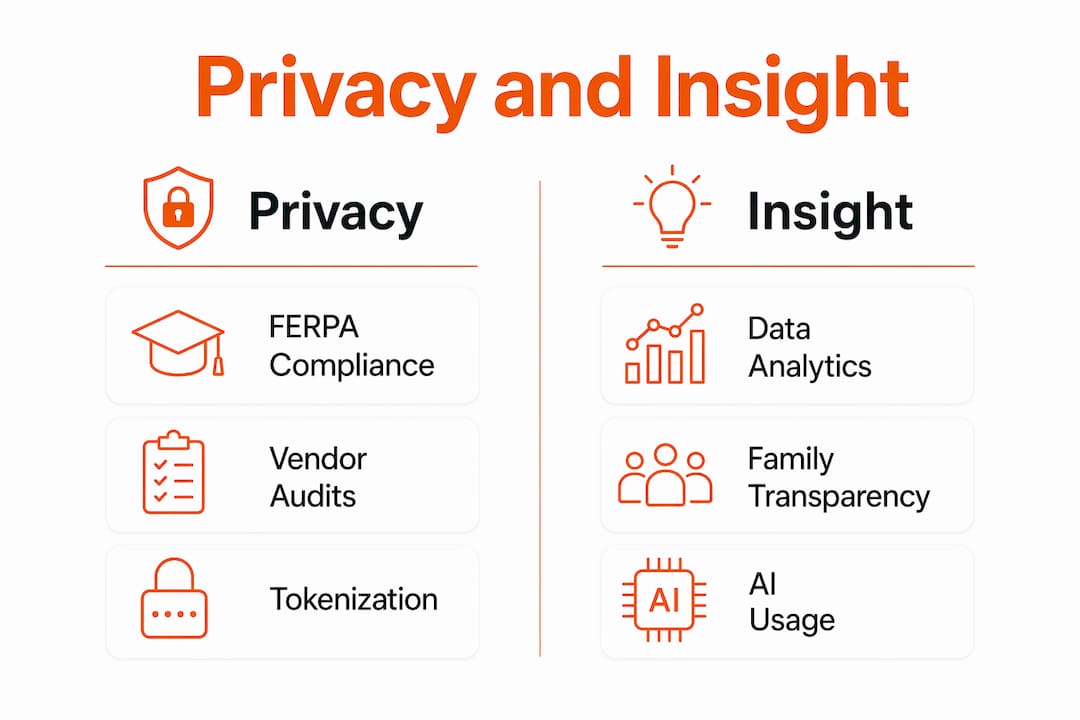
UK GDPR annual notification is the legal minimum, but effective schools go further. They publish plain-language summaries of their data governance policies, hold information sessions for parents at the start of each school year, and provide accessible mechanisms for families to review their child's records and contest inaccurate inferences. When a school's analytics system flags a pupil as at risk of disengagement, parents should know that flag exists and understand the basis for it.
Practical transparency measures include:
- Plain-language data use summaries: Published annually and updated whenever a new vendor or tool is approved, these documents explain what data is collected, who can access it, and for what purpose.
- Family access portals: Systems that allow parents to view their child's records, request corrections, and see which staff members have accessed those records in the past 12 months.
- Contesting inaccurate inferences: Families can request access and rectification under UK GDPR. Schools need a clear process for challenges, including AI-generated comments or flags.
- Engagement in governance culture: Parent advisory groups that include data governance on their agenda create accountability and surface concerns before they become complaints or legal disputes.
Qwixl's parent-facing resources demonstrate how edtech providers can support this transparency obligation by giving families direct visibility into what their child's platform captures and how that information is used.
What privacy risks do AI and behavioral analytics introduce?
AI and behavioral analytics represent a qualitatively different category of privacy concern compared to traditional academic records. Real-time behavioral tracking and sensitive behavioral inferences require ethical design and stricter communication practices than grade records or attendance logs. The distinction matters because behavioral data captures patterns of thought, emotion, and social interaction, not just academic performance.
Location tracking, keystroke monitoring, and sentiment analysis tools can generate inferences about a pupil's mental health, political views, or family circumstances without any explicit disclosure. These inferences may involve special category data and need explicit policy, DPIA-style review and human oversight. ICO guidance on AI and data protection stresses documenting purpose, access and retention for AI features. This regulatory gap creates genuine risk for schools that deploy AI monitoring tools without explicit policies governing their use.
“Privacy defaults can drift when overridden for convenience, requiring explicit policies and communications to maintain balance between privacy and safety.” Jamf, 2026
Schools deploying AI tools must address several specific risks:
- Scope creep in data collection: AI systems designed to detect academic disengagement can easily be configured to monitor communications, flag keywords, or track physical movement. Each expansion requires a new policy decision, not a default setting change.
- Inference transparency: When an AI system generates a behavioral inference about a pupil, that inference should be documented, disclosed to relevant staff only, and made available to families under UK GDPR access provisions.
- Ethical design requirements: Tools should be evaluated not only for what they can do but for what they are configured to do by default. Privacy-preserving defaults are a design choice, and schools should require vendors to demonstrate them.
- Stricter safeguards for sensitive data: Behavioural analytics and location data need explicit policy, minimisation and often a separate lawful basis assessment under UK GDPR.
The quality of data governance policies directly affects the trust and utility of analytics. Schools that invest in clear retention schedules, access logs, and contestation processes produce more reliable insights precisely because their data is cleaner and better governed.
Key takeaways
Schools that protect pupil privacy while generating useful educational insights do so through legal precision, technical minimization, and continuous family communication working together.
| Point | Details |
|---|---|
| Lawful basis and access need precision | Document purpose, role limits and retention for each data use; avoid blanket analytics access. |
| Vendor approval is a privacy decision | Require SOC 2 audits, tokenized identifiers, and sub-processor disclosure before any integration goes live. |
| Transparency builds governance trust | Annual notifications and family access portals are the minimum; plain-language summaries and advisory groups go further. |
| AI tools need explicit behavioral policies | Real-time behavioral analytics require separate consent, documented inferences, and privacy-preserving defaults. |
| Data minimization scales governance | Zero-PII integrations and tokenization reduce exposure at the system layer, making compliance more manageable as tool counts grow. |
Why privacy governance is an ethical commitment, not a compliance checkbox
The schools that handle this well treat privacy as a foundational trust obligation, not a form to file before analytics work begins. Incremental tool adoption without vendor review compounds risk quickly; involving teachers, families, IT and governance leads catches drift early.
How Qwixl supports privacy-conscious educational insight
Qwixl:Homework is designed so meaningful insight does not require intrusive behavioural profiling. Where schools enable it, typing-based screening signals from written assignments may supplement teacher observation (signals, not diagnoses), with documentation schools can share in privacy notices. See Homework insights and privacy and our approach. For pupil-side writing support in Google Docs, Qwixl:Milo is a secondary tool on this school-governance topic.
FAQ
What is the lawful basis for school analytics under UK GDPR?
The lawful basis for school analytics under UK GDPR allows school officials to access pupil records without consent when their role and current task require it. Schools must define both “school official” and “legitimate educational interest” in their annual UK GDPR notification.
How do schools use tokenization to protect pupil privacy?
Tokenization replaces PII with a functional identifier at the system-connection layer, allowing edtech integrations to operate without transmitting names, dates of birth, or other personally identifiable attributes. This limits data exposure while preserving the technical functionality schools need.
What should schools require from edtech vendors before approving an integration?
Schools should require a current SOC 2 Type II audit report, full sub-processor disclosure, documented data deletion obligations, and a data flow diagram before approving any vendor integration. The PowerSchool/Naviance settlement illustrates the cost of skipping these steps.
Why do AI tools in schools require stricter privacy controls than traditional software?
AI tools that perform behavioral or location analytics generate inferences about mental health, social behavior, and emotional states that fall outside traditional academic record protections. These inferences require explicit policies, documented access controls and DPIA-style review under UK GDPR.
How can parents engage with their school's data governance practices?
Parents can request access to their child's personal data, ask for rectification of inaccurate information, and take part in parent advisory groups that include data governance on the agenda. Resources like testing accommodations guidance also illustrate how transparency about data use supports equitable educational outcomes.
Sources and further reading
- ICO UK GDPR guidance hub
- ICO guidance on AI and data protection
- ICO Age Appropriate Design Code (Children's code)
- UK Government data protection overview