
How Schools Identify Learning Difficulties: A Practical Guide
How identification works in England, the inequities that compromise it, and the concrete steps teachers, SENCos and parents can take so no child is overlooked.

Many children with unmet learning needs are misread as lazy, distracted or unmotivated for years before anyone investigates. Understanding how schools identify learning difficulties is not a procedural formality: it is often the difference between a child receiving targeted support and continuing to struggle in silence. Research suggests a large proportion of children are never formally identified at all, and the quieter strugglers are the most likely to be missed. This guide walks teachers, special educational needs coordinators (SENCos) and parents through how identification works in England, the inequities that compromise it, and the concrete steps that help make sure no child is overlooked. Plain-language definitions of the terms used here are in our glossary.
Contents
- Key takeaways
- Common signs of learning difficulties
- How identification works in England
- Who gets identified, and who does not
- What parents and teachers can do now
- What the evidence suggests works
- How Qwixl:Homework supports identification
- FAQ
Key takeaways
| Point | Details |
|---|---|
| Not about intelligence | Specific learning difficulties such as dyslexia and dyscalculia reflect differences in processing, not low intelligence or poor effort (British Dyslexia Association). |
| England has no single screening test | Identification relies on national checkpoints, teacher assessment and the SEN support cycle, which researchers find leaves practice inconsistent between schools (Durham University, 2026). |
| The graduated approach is the framework | Assess, plan, do, review, led by the class teacher and SENCo under the SEND Code of Practice (2015). |
| Identification is unequal | A child's school, gender, family income and first language all affect whether their needs are recognised (Durham University, 2026). |
| Parents and teachers are the first line | Written observations and early conversations with the SENCo speed the path to support. |
Common signs of learning difficulties
Before a school can act, someone has to notice, and that means knowing what to look for beyond low marks.
Specific learning difficulties (SpLDs), such as dyslexia and dyscalculia, are differences in how the brain processes information. They are not linked to a child's intelligence or how hard they try, which is precisely why they are so often misread. In the UK, specific learning difficulty is the accurate term; learning disability means something different, a global intellectual or developmental disability. A child with dyslexia who avoids reading aloud is not being difficult, and a child with dyscalculia who cannot retain times tables is not being careless.
These conditions are common. Around 10% of people in the UK are thought to be dyslexic, about 4% severely, although this is a long-standing estimate rather than a precise epidemiological figure. Dyscalculia affects roughly 6% of people, about one child in a typical class of 30, and NICE estimates that around 5% of children have ADHD. On these estimates, most classrooms will include several children with an identifiable specific learning difficulty or neurodevelopmental condition, though many remain unidentified.
Recognising the signs means looking past surface behaviour. The following indicators appear across age groups and difficulty types:
- Reading and literacy: slow, laboured decoding; difficulty with phonics; letter or word reversals beyond the early primary years; avoidance of reading tasks; poor reading fluency despite repeated exposure.
- Maths and numeracy: persistent confusion with number sequencing or place value; inability to retain number facts despite practice; difficulty reading clocks or handling money.
- Writing: inconsistent spelling of the same word within a single piece; unusually slow writing; difficulty organising written ideas despite strong verbal ability.
- Attention and executive function: frequent loss of materials; difficulty starting or completing multi-step tasks; high distractibility inconsistent with classroom norms.
- Behavioural masking: disruptive behaviour, social withdrawal or school avoidance that coincides with academically demanding periods.
Behaviour can mask underlying difficulty. Reading avoidance may reflect phonological processing challenges, and frustration that looks like defiance can be a response to unmet learning needs rather than a conduct problem. Research from Durham University notes that difficulties often present differently by gender, with boys more likely to act out and girls more likely to struggle quietly with anxiety and inattention. These are signals to explore, not diagnoses, and early, low-pressure conversations between teachers and parents are foundational to timely identification.
How identification works in England
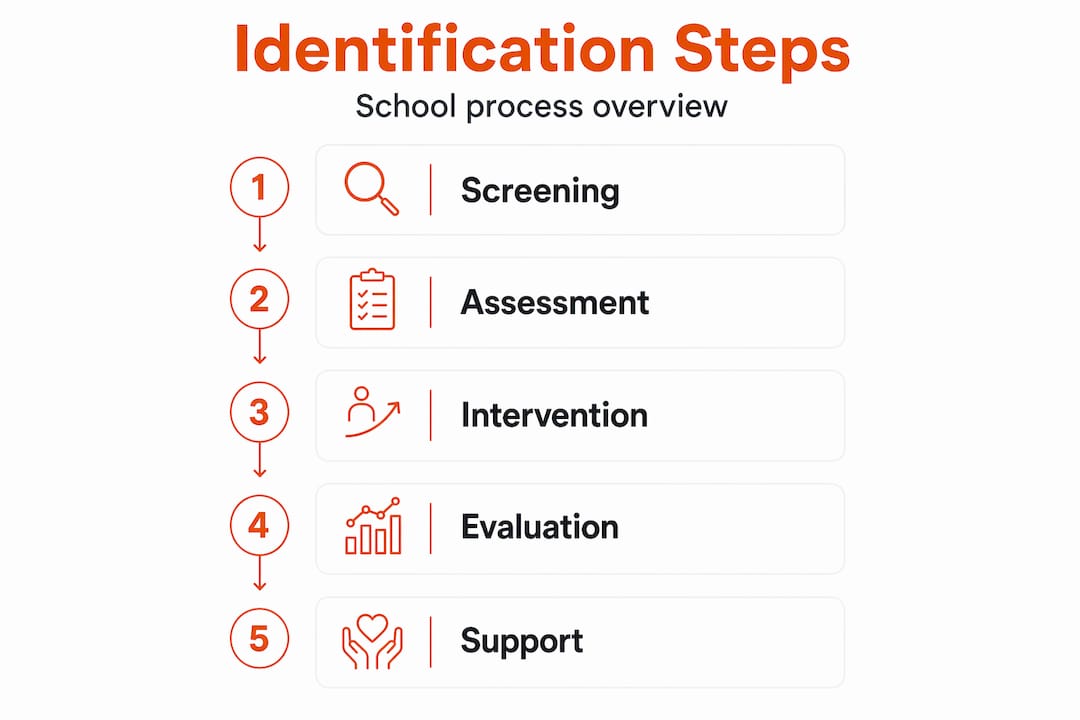
Recognising signs is the beginning; the structured process of identification is what turns concern into documented support. Support in England is governed by the SEND Code of Practice (2015), statutory guidance under the Children and Families Act 2014. In 2024/25, about 1.7 million pupils in England (around 18.4%) were recorded as having SEN, 14.2% receiving SEN support and 5.3% with an education, health and care plan, according to the Department for Education. Schools do not diagnose, and there is no single national screening test for specific learning difficulties. Researchers at Durham University note that the Code offers no clear guidelines for how to identify pupils, which is one reason practice varies between schools. Identification instead rests on a few connected elements.

- High-quality, inclusive teaching first. Most needs are met through good classroom teaching adapted to the pupil, which the Education Endowment Foundation places at the heart of effective SEN provision.
- National checkpoints and teacher assessment. Unlike the United States, England has no thrice-yearly universal screening programme. Schools draw on checkpoints such as the Year 1 phonics screening check and key stage assessments, alongside routine teacher assessment.
- The graduated approach. Where a pupil is identified as having SEN, the class teacher and SENCo put SEN support in place and review it in cycles of assess, plan, do and review, normally at least three times a year with the family.
- The SENCo's role. Every mainstream school must have a qualified SENCo who coordinates provision and advises colleagues.
- EHC needs assessment. If a pupil does not make expected progress despite this support, the family, young person or school can ask the local authority for an education, health and care (EHC) needs assessment. The authority must decide whether to assess and respond within 6 weeks, and where it proceeds the full process up to a final plan must complete within 20 weeks.
This single graduated approach replaced the older School Action and School Action Plus stages in 2015. It is distinct from US frameworks such as Response to Intervention (RTI), multi-tiered systems of support (MTSS) and the IQ-attainment discrepancy model, which are sometimes referenced internationally but do not apply in England. The phases below summarise how a concern typically progresses.
| Phase | Who is involved | Purpose |
|---|---|---|
| Notice and assess | Class or subject teacher, SENCo | Identify a possible need and gather evidence |
| SEN support (graduated approach) | Teacher and SENCo, with the family | Plan, deliver and review adjustments in cycles |
| EHC needs assessment | Local authority, educational psychologist, health and care | Assess complex needs that exceed ordinary SEN support |
| Ongoing review | Teacher, SENCo, family | Track progress and adjust support, at least termly |
A practical note: keep a clear record of what was tried, for how long and how often. A dated account of the support already provided is the evidence base for any request for an EHC needs assessment.
Who gets identified, and who does not
Frameworks only work when they are applied equitably, and the evidence shows they are not. Research from Durham and Oxford universities (2026), analysing records of around 540,000 primary-age children in England, found that whether a child is identified depends not only on attainment but on their school, gender, family income and first language.
The patterns are stark:
- School context. Children in higher-achieving schools are more likely to be identified, because their difficulties stand out against a higher-achieving peer group. A child in a lower-achieving school may struggle at the same level and not be referred because their performance looks typical for that setting.
- Gender. After accounting for academic attainment, boys were about twice as likely as girls to be identified. Girls who struggle quietly with anxiety and inattention are more easily overlooked, which delays support.
- Income and first language. Children from deprived areas and those with English as an additional language are less likely to be recognised, partly because their difficulties are attributed to language acquisition or disadvantage rather than an underlying need.
The researchers also found that fewer than 2% of pupils in England are identified as having a specific learning difficulty, against international estimates that 5 to 10% are affected. As the Durham team put it, every child should have an equal chance of having their needs recognised regardless of their background, gender, family circumstances or which school they attend. Private assessment is one route some families take, but it can cost hundreds of pounds and, the researchers warn, widens inequality.
Our companion piece on undiagnosed SEN students in UK schools looks at how these gaps compound across a child's time in school.
What parents and teachers can do now
Formal processes take time, and the steps taken before and during them affect how quickly a child receives support. The single most useful habit is a structured observation record: specific behaviours with dates, subjects and examples rather than general impressions. "3 October: unable to decode three-letter words read successfully last week" carries far more weight than "reading has got worse".
Additional steps that make a measurable difference:
- Raise concerns early with the class teacher and the school SENCo, and ask how the graduated approach (assess, plan, do, review) will be applied.
- Ask what SEN support is in place and when it will be reviewed, normally at least once a term.
- Request an EHC needs assessment if progress is not made despite support. A parent, young person or school can ask the local authority; it must respond within 6 weeks, and the full process runs to 20 weeks.
- Get free, independent advice. IPSEA offers guidance on your rights and on requesting an assessment or appealing a decision.
- Collaborate across roles. The most effective identification happens when teachers, parents and specialists share observations regularly, not only at formal meetings. A parent who notices that reading homework takes four times longer than it should is providing genuinely useful evidence.
A practical note: if a local authority declines to carry out an assessment, it must explain why in writing, and you have the right to appeal. That letter is the starting point for independent advice or an appeal.
What the evidence suggests works
Two patterns recur across the research. The first is that the schools which identify learning difficulties most effectively are not necessarily those with the most advanced tools. They are the ones where teachers feel confident to raise concerns early, where there is a clear pathway from observation to the SENCo, and where the SENCo is integrated into day-to-day teaching decisions rather than confined to paperwork. The Education Endowment Foundation's guidance on SEN in mainstream schools reaches a similar conclusion: high-quality inclusive teaching comes first, followed by building a holistic understanding of the pupil, careful use of targeted small-group and one-to-one support, and the deliberate deployment of teaching assistants.
The second is that identification is shaped as much by who a child is and where they go to school as by their actual needs. The structural fix the evidence points to is consistency: clearer identification guidance, shared observation practices across teaching and support staff, and decisions built on multiple evidence points gathered over time rather than a single impression. The stakes are high. The EEF notes that by the end of primary school the gap between pupils with identified SEND and their peers has, on average, been more than twice as wide as the gap linked to disadvantage.
How Qwixl:Homework supports identification
Knowing what to look for is one thing; capturing it consistently across a whole class is another, and it is where identification most often breaks down. Qwixl:Homework is built for that gap. It provides AI-assisted marking and feedback alongside class-level, SEN-informed insight signals drawn from writing patterns and engagement, giving teachers and SENCos an evidence base for early conversations. It surfaces signals to inform the SENCo's professional judgement within the assess stage of the graduated approach; it does not diagnose, label or replace statutory SEN processes, which remain with qualified staff. You can read more about how Qwixl:Homework works. For the student-side writing tool that some families use while waiting for support, see Qwixl:Milo.

FAQ
How do schools identify learning difficulties?
In England, schools use national checkpoints, routine teacher assessment and the graduated approach of assess, plan, do and review under the SEND Code of Practice (2015), led by the class teacher and SENCo. Where needs are more complex, the local authority co-ordinates an EHC needs assessment. Schools themselves do not diagnose.
What are the early signs of learning difficulties?
Common signs include laboured reading, persistent difficulty with number facts, unusually slow or disorganised writing, and avoidance of academic tasks. These are often mistaken for laziness or inattention, which is why structured observation and early communication matter.
Can parents request an assessment?
Yes. A parent, young person or school can ask the local authority for an EHC needs assessment. The authority must decide whether to assess and respond within 6 weeks, and complete the process within 20 weeks, or explain in writing why it declines, with a right of appeal.
How is England's approach different from the US system?
The United States uses Response to Intervention and an IQ-attainment discrepancy model under federal law (IDEA). England uses the graduated approach (assess, plan, do, review) under the SEND Code of Practice 2015; there is no IQ-discrepancy test and no federal 60-day timescale.
Why are some children with learning difficulties not identified?
Research from Durham University shows that gender, family income, first language and school context all affect identification. After accounting for attainment, boys are about twice as likely as girls to be identified, while girls who struggle quietly, children with English as an additional language and children from deprived areas are consistently under-identified.
Sources and further reading
- SEND Code of Practice: 0 to 25 years (2015)
- IPSEA, Asking for an EHC needs assessment
- DfE, Special educational needs in England, 2024/25
- Durham University, why some children get identified and others do not (2026)
- Education Endowment Foundation, Special Educational Needs in Mainstream Schools