
SEN Screening Tools for Teachers: 2026 Guide
How to choose and use screening well: what the evidence shows, how screening fits the SEND graduated approach, and where it stops and professional assessment begins.

SEN screening tools are brief, structured checks that help teachers and SENCOs spot pupils who may need a closer look, so that support can begin early rather than after difficulties have escalated. They produce early evidence, not a diagnosis: their job is to guide classroom adjustments and inform referrals, not to label a child or replace a statutory assessment. In England, 19.6% of pupils, more than 1.7 million children, were recorded as having special educational needs in January 2025, of whom 14.2% were on SEN support and 5.3% held an Education, Health and Care (EHC) plan (Department for Education). Behind those figures are many pupils whose needs are recognised late, which is why how schools screen matters. Plain-language definitions of the terms used here are in our glossary.
Screening is not diagnosis
The single most important distinction is between screening and diagnosis. Screening identifies pupils who may need further investigation and justifies early, targeted classroom support. Diagnostic assessment, carried out by qualified specialists such as educational psychologists, determines the nature and extent of a specific condition. Treating a screening result as a diagnosis risks both false reassurance and unfair labelling; treating screening as too risky to use at all leaves pupils without support for longer than necessary.
What makes a screening tool useful in the classroom
For a teacher working under time pressure, the value of a screening tool lies less in its branding than in whether it fits real classroom routines. Useful tools tend to share a few practical qualities.

- Speed. A check that takes a few minutes can be used across a whole class or year group; a 45 minute assessment cannot.
- Actionable output. A result that simply flags a pupil as "at risk" without suggesting next steps leaves teachers without direction. The most useful tools point towards classroom adjustments and indicate when to involve the SENCO.
- Fits existing workflows. Tools that bolt on another login, dashboard or reporting burden tend to be abandoned. Those that draw on what teachers already do are more likely to be used consistently.
- Supports tiered planning. Output should help plan support at different levels and feed the documentation the SEND system expects.
- Sound data handling. Anything capturing pupil data must meet data protection requirements and keep information proportionate and secure.
Where screening fits in the SEND graduated approach
In England, screening sits inside the statutory framework set out in the SEND Code of Practice. Support follows a graduated approach of assess, plan, do and review, built on high quality teaching as the essential first step. Screening belongs at the "assess" end of that cycle: it helps a school notice and describe a need, which then informs planning and review.
This matters for funding and statutory decisions. When a parent or school requests an EHC needs assessment, the local authority must decide whether to carry it out within 6 weeks of the request, and where a plan is needed the whole process should take no more than 20 weeks from request to final plan (Special Educational Needs and Disability Regulations 2014; SEND Code of Practice, 2015). Assessment panels expect evidence that high quality, targeted support was already tried, so the records screening helps produce are not merely administrative: they form part of the case for support. Our guide to the EHC plan process explains the stages in more detail. Schools in Scotland work to a different framework, Getting it right for every child (GIRFEC); the graduated approach described here applies in England.
What the evidence says about screening
Screening is not a magic wand, but the evidence is encouraging where it is used systematically. A Department for Education rapid evidence review (2025) found that structured screening tools, such as questionnaires and checklists, can be more accurate than teacher nomination alone, particularly for less visible "internalising" difficulties like anxiety, and that identification works best when it is systematic, structured and proactive. The widely used Strengths and Difficulties Questionnaire is among the most reviewed tools. Screening signals where to look more closely; it does not by itself prevent difficulties or replace assessment.
Types of screening tool, and who uses them
Rather than ranking branded products, it helps to think in categories and to match the tool to the user and the purpose.
| Type | What it looks at | Typical user |
|---|---|---|
| SEMH rating scales and questionnaires | Social, emotional and mental health needs (for example the Strengths and Difficulties Questionnaire) | Class teachers, pastoral staff |
| Executive function and learning screeners | Attention, working memory, planning, early literacy signals | Class teachers, SENCOs |
| Engagement and pattern tools | Everyday work and homework patterns over time | Teachers, SENCOs |
| Cognitive and achievement batteries | In depth cognitive profiling (for example cross battery systems such as X-BASS) | Educational psychologists, specialists |
Some tools are designed for whole class teacher use; others, such as the cross battery assessment system X-BASS (Flanagan, Ortiz and Alfonso, 2025), are specialist instruments used by educational psychologists once a teacher's initial screening has flagged a pupil for review. Several popular tools are commercial products whose marketing figures, for example claimed time savings, are supplier claims rather than independently evaluated results, so it is worth asking any provider for a sample output report and for evidence before adopting their tool.
Using screening well in practice
Tools matter less than how consistently they are used. A few habits make screening effective rather than a one off exercise.
- Screen at transition points. The start of a year, after a long break, or the move to a new key stage are high yield moments, and a single screen is not a substitute for ongoing monitoring.
- Document using assess, plan, do, review. Structured evidence of what was tried, and how the pupil responded, is what funding and assessment decisions rest on.
- Involve the SENCO early. The legal test for an EHC assessment expects evidence of high quality prior support, so the SENCO should be part of the process from the first result, not only at referral.
- Share results with parents in plain language. Screening is most useful when families understand what it does and does not mean. Our student support plan checklist can help structure those conversations.
- Use tools to reduce admin, not to replace judgement. AI assisted tools can speed up drafting, but statutory decisions and final documentation remain the responsibility of qualified staff.
Why early, school level identification matters
The pressure on the formal system makes early identification more important, not less. DfE data shows 638,700 children and young people had an active EHC plan in January 2025, up 10.8% in a year, with 154,500 requests for an assessment during 2024, an 11.8% rise. Autism is the most common primary type of need in EHC plans (31.5%), followed by speech, language and communication needs and social, emotional and mental health needs. Meanwhile the Children's Commissioner reports SEND tribunal appeals at record highs, with most decided at least partly in families' favour. Earlier, well evidenced support at school level can help some pupils before needs escalate to dispute. Our guides on how educators identify struggling students early and how schools identify learning difficulties go deeper, and our overview of undiagnosed SEN in UK schools sets out the wider scale.
What the evidence tells us about getting screening right
Two patterns come up repeatedly in the research and guidance. The first is that screening works best as a continuous practice rather than a one off administrative task: needs evolve, and tools embedded in routine monitoring catch more than those used only when a crisis has already arrived. The second is the persistent confusion between screening and diagnosis, which can make staff hesitant to use screening at all. As the DfE evidence review makes clear, structured screening is there to guide early support, not to diagnose, and used with that understanding it can be applied earlier and more confidently. A good tool used consistently, with the assess, plan, do, review cycle treated as professional practice rather than paperwork, tends to open more doors than a sophisticated tool used once.
How Qwixl:Homework supports screening in your classroom
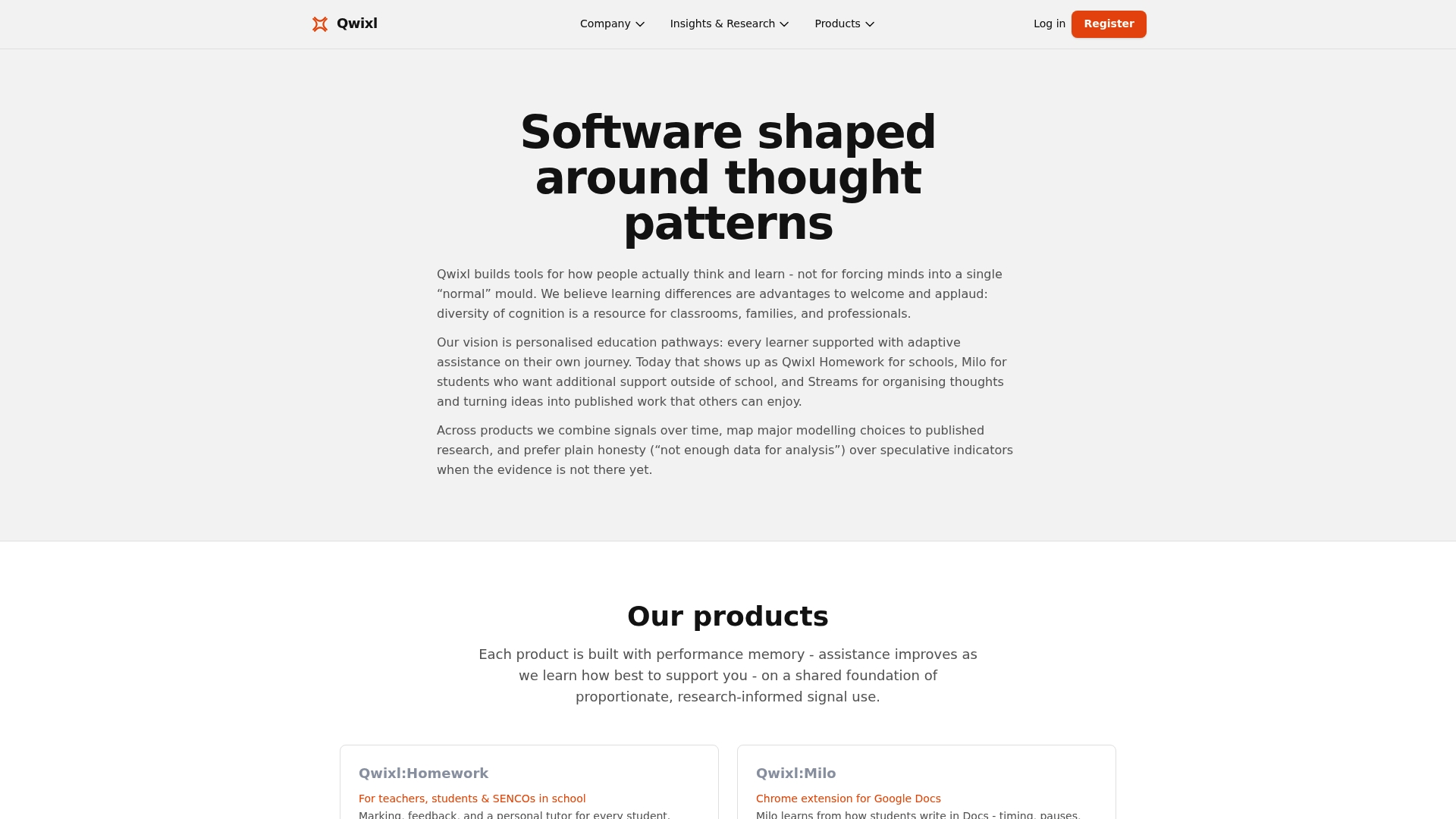
Qwixl:Homework is built for the gap that one off screening tools leave open: the space between an initial signal and a formal referral. It surfaces class level patterns and screening signals from everyday homework, writing and engagement, helping teachers and SENCOs notice pupils who may need a closer look earlier, without diagnostic labels or intrusive data collection. Used alongside the SEND graduated approach, it supports the "assess" end of the cycle and strengthens the documentation trail that assessment panels expect, while statutory decisions stay with qualified staff. These are screening signals to inform professional judgement, not a diagnosis.
FAQ
What are SEN screening tools for teachers?
SEN screening tools are brief, structured checks that help teachers identify pupils who may have special educational needs requiring additional support. They provide early evidence to guide classroom adjustments and referrals, not formal diagnoses.
How long does a typical SEN screening check take?
It varies by tool. Many classroom rating scales and questionnaires take only a few minutes, while in depth cognitive assessments carried out by specialists take much longer.
Can screening results be used in EHC referrals?
Screening results contribute to the evidence base, but local authorities also expect documentation of sustained, high quality support using the assess, plan, do, review cycle before agreeing to a formal assessment.
What is the difference between screening and diagnostic assessment?
Screening identifies pupils who may need further investigation and justifies early classroom support. Diagnostic assessment, conducted by qualified specialists, determines the nature and extent of a specific condition.
How often should teachers screen for special educational needs?
Screening at key transition points, such as the start of a year or key stage, is a sensible minimum, and ongoing monitoring gives a more complete picture of evolving needs.
Sources and further reading
- DfE, Special educational needs in England, January 2025
- DfE, Education, health and care plans, 2025
- DfE, Identifying and supporting children and young people with SEMH needs: a rapid evidence review (2025)
- SEND Code of Practice: 0 to 25 years (2015)
- Special Educational Needs and Disability Regulations 2014
- Children's Commissioner for England, EHC plan statistics