
How to Support Students with Dyslexia in the Classroom
Structured literacy, reasonable adjustments and assistive technology for pupils with dyslexia, including those not yet formally identified.

Dyslexia is a specific learning difficulty that affects phonological processing, decoding and fluency. It is not linked to intelligence or how hard a pupil tries (British Dyslexia Association). Effective classroom support needs two parallel tracks: explicit, systematic teaching that builds foundational reading skills, and consistent reasonable adjustments that provide equitable access to age-appropriate content. Around 10% of people in the UK are thought to be dyslexic, about 4% severely, yet identification remains inconsistent: research suggests fewer than 2% of pupils in England are recorded with a specific learning difficulty, against estimates that 5 to 10% may be affected (Durham University, 2026). Most teachers are already working with unidentified dyslexic learners. Plain-language definitions are in our glossary.
Classroom adjustments that support pupils with dyslexia
Reasonable adjustments under the Equality Act 2010 are access tools, not concessions. They let pupils demonstrate what they know without decoding barriers obscuring content understanding. When adjustments are woven into everyday routines and offered class-wide where possible, pupils use them confidently and without stigma. See our guide on reasonable adjustments in UK schools.
Presentation adjustments
Presentation tools change how information reaches the pupil. Text-to-speech (for example Microsoft Immersive Reader, built into many school platforms) lets pupils access written material through listening. Visual highlights, chunked passages and clear fonts reduce perceptual load. Separating decoding from comprehension matters: a pupil who struggles to decode but understands when text is read aloud needs a different instructional response than a pupil with comprehension difficulty.

Response, setting and timing adjustments
- Presentation: text-to-speech, visual highlights, chunked passages, dyslexia-friendly formatting
- Response: speech-to-text, oral answers where appropriate, typed rather than handwritten responses, reduced copying from the board
- Setting: preferential seating, reduced visual clutter, quiet space for assessments where needed
- Timing: additional time on tests and timed writing where the timing barrier is unrelated to content knowledge (a common reasonable adjustment in England)
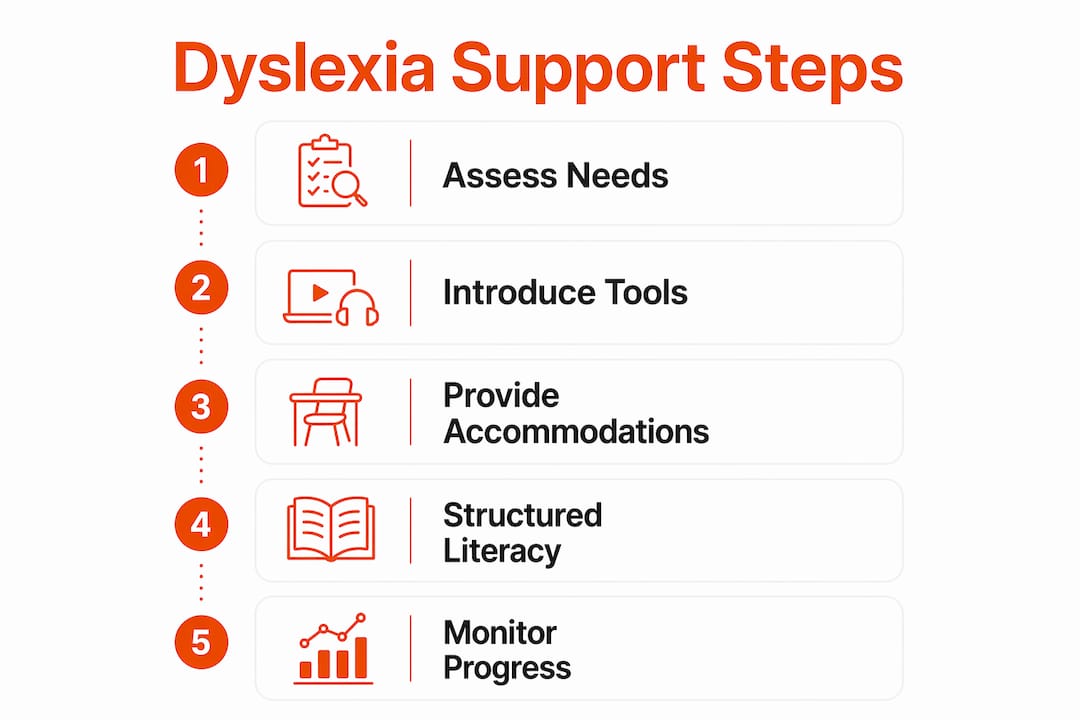
A practical approach: introduce a small set of tools to the whole class so no individual is singled out. A structured rollout over a few weeks, with two presentation and two response options, gives pupils time to build confidence before fine-tuning. Our school support options guide complements this framework.
Structured literacy and systematic phonics
Structured literacy is explicit, systematic and cumulative. It addresses the phonological processing difficulties that characterise dyslexia through a carefully sequenced progression. The Education Endowment Foundation reports strong evidence for systematic synthetic phonics as part of early reading instruction. Programmes based on Orton-Gillingham principles (such as Wilson or Barton in some settings) follow a similar explicit, multisensory logic.
- Phonological awareness first: hearing, identifying and manipulating sounds in spoken language before connecting sounds to letters.
- Explicit phonics: each sound-spelling correspondence taught directly, practised to automaticity, reviewed before new patterns are introduced.
- Multisensory pathways: visual, auditory and kinesthetic channels used together where helpful.
- Fluency practice: supported reading with decodable texts once decoding is established.
- Connected text: progressive application from words to sentences to longer passages at the pupil's current decoding level.
Structured literacy and adjustments must run simultaneously, not sequentially. Waiting until a pupil catches up before providing text-to-speech or additional time denies access during the period when support is most needed. Our guide on assistive technology for learning covers how technology fits alongside teaching.
Assistive technology for reading and writing
Assistive technology addresses barriers to reading text, producing written output, and accessing curriculum materials in alternative formats.
| Tool | Primary function | Notes |
|---|---|---|
| Microsoft Immersive Reader | Text-to-speech with highlighting | Built into Microsoft 365; widely used in UK schools |
| RNIB Bookshare | Accessible curriculum texts | UK accessible books service for qualifying print-disabled learners |
| Speech-to-text (various) | Dictation for written work | Built into many devices and platforms |
| Coloured overlays / formatting | Reduce visual stress for some readers | Effect varies by individual |
Reading comprehension is often stronger when content is accessed orally, which is why separating decoding from comprehension is critical for both assessment and instruction.
Organising the classroom to reduce barriers
- Post key vocabulary visually so pupils can reference terms independently.
- Maintain consistent routines so pupils spend less working memory on what happens next.
- Give instructions in numbered steps, written and left visible during the task.
- Avoid forced public reading or spelling; volunteer-only reading and private checks reduce anxiety.
- Provide notes as standard practice rather than requiring copying from the board.
- Chunk longer assignments with clear checkpoints so progress is visible.
Universal design benefits all learners and prevents adjustments feeling like markers of difference.
Key takeaways
| Point | Details |
|---|---|
| Prevalence exceeds identification | About 10% may be dyslexic; many remain unidentified in school records. |
| Adjustments normalise access | Presentation, response, setting and timing supports work best when embedded in daily routines. |
| Structured literacy builds decoding | Explicit, systematic phonics is strongly evidenced; run alongside adjustments, not instead of them. |
| Technology separates decoding from comprehension | Text-to-speech and speech-to-text let pupils show what they understand. |
| Attainment gap is substantial | BDA reports a large GCSE attainment gap for pupils with dyslexia/SpLD; early support matters. |
What the evidence suggests in practice
Most teachers understand dyslexia is not a motivation problem. The gap is between knowing what adjustments exist and embedding them daily without marking pupils out. Reserving adjustments only for formally diagnosed pupils leaves most affected learners unsupported; class-wide access to text-to-speech and printed notes closes that gap without requiring a label.
Instruction and adjustment are not in tension. Systematic phonics builds decoding over time; adjustments ensure pupils can access content and demonstrate knowledge while those skills develop. Collaboration with the SENCo and families, with shared observations and regular review under the graduated approach, keeps support consistent and responsive.
How Qwixl:Homework supports dyslexia-aware teaching

Qwixl:Homework helps teachers notice patterns in written work and engagement across a class, surfacing signals that may indicate unmet literacy needs before a formal identification. It supports assignment workflows, AI-assisted feedback and class-level insight (signals, not diagnoses) to inform conversations with the SENCo. For pupils building evidence at home in Google Docs, Qwixl:Milo offers a brief, student-side complement. Neither tool diagnoses dyslexia or replaces statutory SEN processes.
FAQ
What is the most effective instructional approach?
Explicit, systematic structured literacy with systematic synthetic phonics is strongly evidenced. Programmes based on Orton-Gillingham principles follow a similar logic in many specialist settings.
How does additional time help on assessments?
It gives pupils processing space to decode questions and formulate responses without a timing barrier unrelated to content knowledge. It is a common reasonable adjustment in England.
Can adjustments be used without a formal diagnosis?
Yes. Class-wide reasonable adjustments and high-quality inclusive teaching benefit every learner. Formal identification supports more individualised plans where needed.
What is the difference between an adjustment and changing the standard?
An adjustment changes how a pupil accesses or demonstrates learning without altering the expected standard. Changing the standard itself is a different decision with different implications.
How can teachers spot possible undiagnosed dyslexia?
Persistent phonological difficulty, slow or inaccurate decoding, reading avoidance, and a gap between oral understanding and written output are consistent signals. Consult the SENCo and see how schools identify learning difficulties.
Sources and further reading
- British Dyslexia Association
- EEF, Preparing for Literacy and systematic phonics
- EHRC, Reasonable Adjustments for Disabled Pupils
- BDA, Mind the Gap report (2025)