
Why Homework Patterns Reveal Struggles in Students
What time-on-task, effort and consistency at home can show about learning and wellbeing, before marks flag a problem.

Homework patterns can be a useful early signal of a pupil's learning challenges, shaped by self-regulation, motivation and the quality of support from parents and teachers. When adults look beyond simple completion rates, how a pupil engages with homework (when they start, how long they persist, where attention goes, how much effort they invest) often reflects more about underlying cognitive and emotional functioning than a single grade. This article summarises what the research suggests about process-level homework behaviour, and what teachers, SENCos and parents can do with that information. Plain-language definitions are in our glossary.
Why homework patterns matter: process over product
Homework patterns are the observable behaviours around assignment completion: time allocation, persistence, distraction, effort quality and consistency across subjects and weeks. Research on self-regulated learning (Zimmerman, 2002) suggests that how homework is done often matters as much as whether it is finished. That reframes monitoring: the goal is not only to track completion but to understand what interrupts work and what helps it flow.
Self-Determination Theory is one widely used framework: pupils who experience autonomy support from adults tend to develop stronger internal motivation and more durable self-regulation (Ryan & Deci, 2017). When support is absent or overly controlling, fragmented effort, avoidance and inconsistent completion are common. These are often motivational and cognitive signals that warrant a structured response, not simply a discipline issue.

Process patterns are valuable because they can emerge before formal assessments flag a problem. A pupil who consistently starts late, abandons tasks midway, or produces work far below their in-class standard may be communicating something specific. Noticing that signal early can mean timelier support.
Time management and distraction
Time management during homework is among the clearest process indicators. Long sessions with little output, frequent stopping and restarting, difficulty beginning without heavy prompting, or work that lacks depth despite reported time investment all warrant closer attention.
Distraction takes different forms, and distinguishing them helps. Digital distraction (notifications, device switching) differs from cognitive distraction, where attention drifts because the task exceeds current processing capacity or anxiety is consuming working memory. A pupil who re-reads the same paragraph repeatedly may be showing a comprehension or decoding difficulty; one who is persistently off-task may be showing an engagement or executive function difficulty. Both are worth recording, but they point towards different next steps.
A practical habit: note where homework time actually goes, not only how long it lasted. Parents often see this at home; teachers often see only the finished product. Sharing specific observations (dates, subjects, examples) closes that gap. Our guide on how parents can support identification explains how to document patterns well.
Effort, completion and motivation
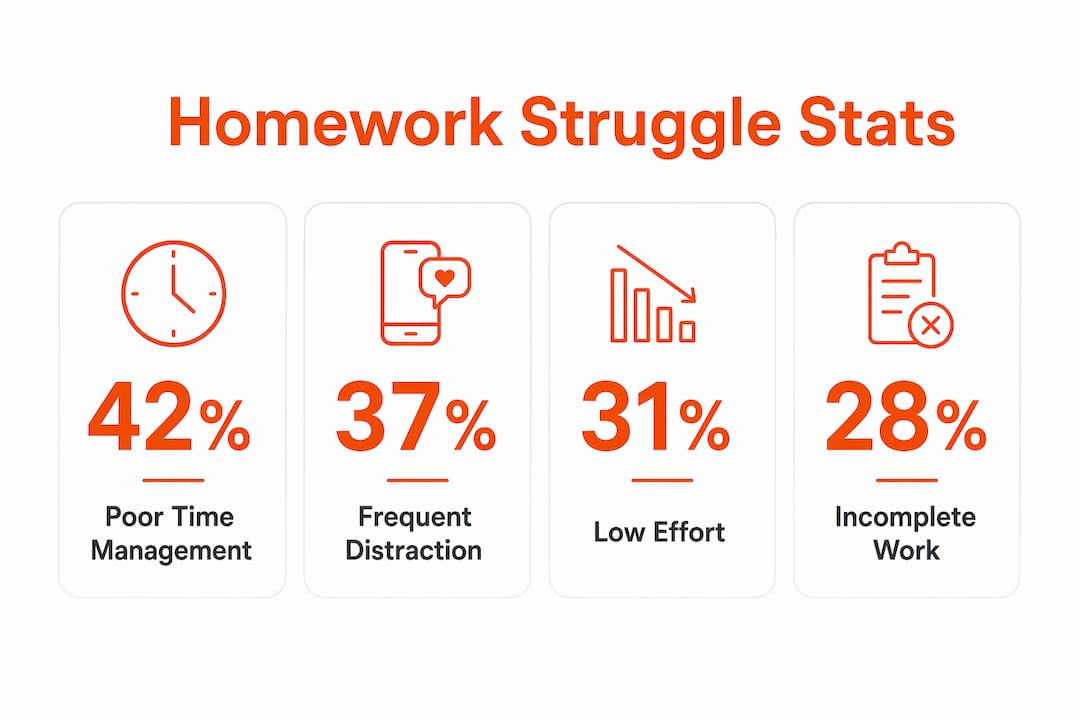
Homework effort and homework completion are not the same variable, and treating them as identical can mislead conclusions about motivation. Longitudinal work on autonomy support suggests parents often respond to perceived effort (process), while teachers more often evaluate completion (product) (EEF, Working with Parents). Both perspectives matter.
| Dimension | Teacher view (typical) | Parent view (typical) |
|---|---|---|
| Primary signal | Completed work submitted | Effort and process during the task |
| Strength | Consistent across a class | Responsive to the individual child |
| Risk if ignored | Compliance without understanding | Persistence and self-regulation unsupported |
A pupil who submits completed homework but invests minimal effort is not necessarily thriving. Looking for effort variation across subjects often helps: strong completion in maths but minimal effort in writing may signal a subject-specific difficulty rather than general low motivation.
Attendance, wellbeing and homework together
Homework struggles rarely exist in isolation. The NHS survey Mental Health of Children and Young People in England, 2023 found that about 1 in 5 children and young people aged 8 to 25 had a probable mental disorder, which can affect initiation, persistence and sensitivity to perceived failure on homework tasks.
Attendance and homework engagement can interact. In England, persistent absence is defined as missing 10% or more of possible sessions; in 2024/25, 18.14% of pupil enrolments were persistently absent (DfE, 2024/25). Pupils who miss instruction face heavier cognitive load on homework, which can increase avoidance. Triangulating homework trends with attendance and wellbeing indicators, as our guide to early identification describes, often gives a fuller picture than any single metric alone.
How task design reveals or masks difficulty
Task design influences whether struggle patterns become visible. Unclear instructions, excessive load, or homework used only as exam preparation can produce low completion that reflects design as much as capability. Formative tasks with clear success criteria and manageable steps tend to generate more interpretable process data.
Written homework is especially informative for literacy-related difficulties: inconsistent spelling, unusually slow production, or strong verbal understanding with weak written output are patterns worth recording. Digital formats can capture time-on-task and revision behaviour when designed for formative use, though poor design can hide struggle behind superficial completion.
| Format | Strengths for noticing struggle | Risks |
|---|---|---|
| Paper homework | Shows handwriting, organisation, effort on the page | Teacher sees mainly the product |
| Digital homework with feedback | Can capture attempts and time-on-task | Gamification can mask underlying difficulty |
| Formative tasks | Process data useful alongside teacher judgement | Requires time to interpret signals |
Key takeaways
| Point | Details |
|---|---|
| Process over product | How homework is done often matters as much as whether it is finished. |
| Autonomy support | Encouraging choice, explaining rationale and responding to effort supports sustained engagement. |
| Triangulate signals | Homework patterns alongside attendance and wellbeing data can surface difficulties earlier. |
| Task design matters | Clear, formative tasks make struggle patterns easier to interpret. |
| Parents and teachers see different halves | Structured sharing of process observations bridges the gap. |
What the evidence suggests in practice
One recurring pattern is treating non-completion as laziness when context is missing: unclear tasks, weak autonomy support, or executive function difficulties. Shifting the question from "did they finish?" to "how did they spend the time?" often changes the picture. A pupil who spent 45 minutes and produced three sentences may be signalling processing, confidence or comprehension difficulty; that is more actionable than a binary incomplete mark.
The school-home split is another barrier. Parents see effort and process; teachers see product and deadlines. Families and schools that share structured observations about behaviour, not only grades, tend to identify difficulties earlier. Personalised homework support and usable written feedback are part of the same picture: reduce unnecessary barriers while keeping expectations clear.
How Qwixl helps you act on homework patterns

For families, Qwixl:Milo works in Google Docs and surfaces processing indicators (signals, not diagnoses) as a pupil writes, with an evidence pack for meetings while formal processes run. For schools, Qwixl:Homework captures class-level engagement and writing signals from assignments, helping teachers and SENCos notice process-level changes before they escalate. Both support professional judgement; neither diagnoses nor replaces statutory SEN processes.
FAQ
What do homework patterns reveal?
They can reveal self-regulation difficulties, motivational context, and cognitive or emotional barriers that may not yet appear in formal assessments. Process variables such as persistence and effort quality are often more informative than completion alone.
Why might a pupil struggle with homework despite understanding the material?
Executive function difficulties, anxiety, lack of autonomy support, or poorly designed tasks are common contributors, not only subject knowledge gaps.
How are homework struggles connected to attendance?
Missed learning increases homework difficulty, which can increase avoidance; attendance and homework data are best read together. See our early identification guide.
What is autonomy support?
Adults encouraging pupil choice, explaining why tasks matter, and responding to effort rather than controlling behaviour. The EEF notes that parental engagement focused on learning habits and routines can support homework persistence alongside school practice.
How can teachers use homework data early?
Analyse how time is spent and whether effort varies by subject, not only whether work was submitted. Patterns such as re-reading, inability to start, or subject-specific collapse warrant follow-up with the SENCo and family.
Sources and further reading
- NHS England, Mental Health of Children and Young People in England, 2023
- DfE, Pupil absence in schools in England, 2024/25
- EEF, Working with Parents to Support Children's Learning
- EEF, Special Educational Needs in Mainstream Schools
Recommended
Notice homework patterns while you wait for answers
Milo is a Chrome extension that works inside Google Docs. It learns from how your child writes (typing patterns, pauses, corrections) and surfaces early indicators that may be worth exploring further. It provides adaptive writing support from the first session. No referral. No waiting list. No assessment fee.